Laboratory for Diagnostics and Therapy of Cardiovascular-Respiratory System
Team
Krzysztof Zieliński, PhD Eng. – Head of the Lab
Prof. Marek Darowski, PhD, DSc
Assoc. Prof. Tomasz Gólczewski, Phd. DSc. Eng.
Maciej Kozarski, PhD Eng.
Jeremi Mizerski, PhD MD
Krzysztof Pałko, PhD Eng.
Barbara Stankiewicz, PhD
Anna M Stecka, PhD Eng.
Current research activities:
A. Simulators and computer models
Proposing new or improved equipments and new or improved methods for supporting and testing the circulatory and respiratory systems has been the leading topic in the Laboratory since its establishment. As initial testing of new solutions on living patients is out of the question for ethical reasons, we have been developing simulation methods. Particularly noteworthy is the construction of an artificial respiratory and circulatory patient(Kozarski et al., 2015; Zieliński et al., 2019a; Zieliński et al., 2019b, Fresiello et al., 2020; Zieliński et al., 2020; Zieliński et al., 2022a; Pasledni et al., 2022; Pałko et al., 2024; Pasledni et al., 2024),which is a hybrid physical-numerical model. The hybrid model combines the basic advantage of a physical model, which is the ability to test physical equipment, with the advantages of computer models, including, above all, the ability to take into account everything that is important in a given case and can be described mathematically.
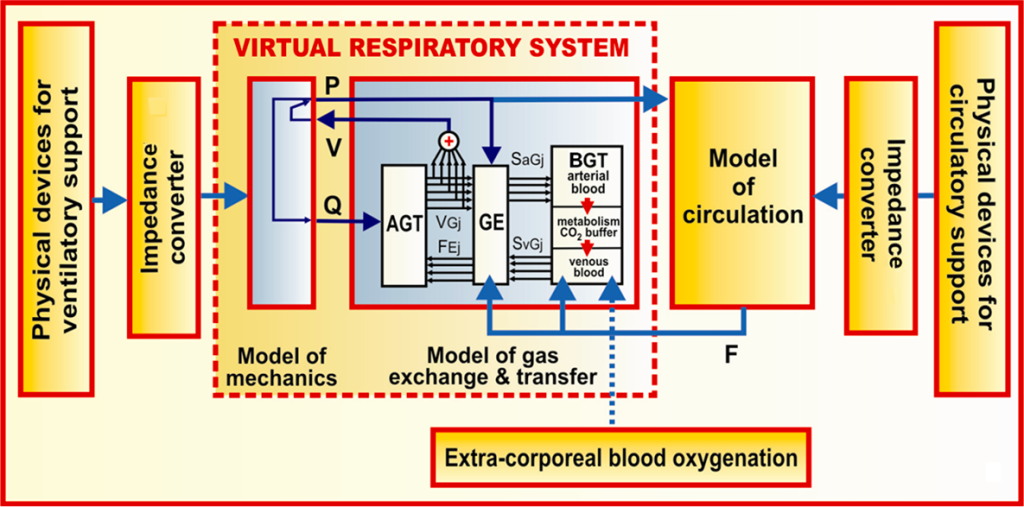
Schematic of an artificial patient. AGT, GE and BGT are models of: bronchial gas transfer, gas exchange and gas transport with blood, respectively.
Our artificial patient is composed of two simulators coupled with each other: the Hybrid Circulatory System Simulator (HSUK) and the Hybrid Respiratory System Simulator (HSUO). Each of them consists of two main parts – a numerical model and a physical-computer interface(Zieliński et al., 2016which is the link between the real world represented by physical supporting devices (e.g. ventilator or blood pump) or diagnostic devices (e.g. spirometer) and the digital world represented by numerical models. Over the years, HSUK in various versions has been sold to the Foundation for the Development of Cardiac Surgery, the AGH University of Science and Technology and, together with HSUO, to the Warsaw University of Technology. In addition, one HSUK was loaned to the Catholic University of Leuven, where it was upgraded and used in scientific collaboration under a commercial-scientific agreement(Fresiello et al., 2022a, Rocchi et al., 2021, Colasanti et al., 2020),as well as offered as a service for testing newly developed heart assist devices(Fresiello et al., 2022b).This unit was sold to the University of Twente after the contract ended.
The Laboratory has developed several versions of HSUO, differing in their pneumatic-computer interface, dedicated to various applications: simulating spirometry, simulating the respiratory system of an adult (Zieliński et al., 2022a) as well as pediatric patients and infants (Stankiewicz et al., 2017a; Stankiewicz et al., 2017c; Stankiewicz et al., 2019a).
The circulatory part of the numerical model consists of a series of lumped parameter models simulating the mechanics of the heart and coronary circulation, systemic circulation and pulmonary circulation. Each of these models is additionally equipped with a model of gas transport with blood. Additionally, the entire circulatory system model is supplemented with a model of metabolism in tissues, autoregulation using the baroreceptor system and a model of pulmonary vasoconstriction.
The most advanced numerical component of HSUO is a virtual respiratory system consisting of several models exchanging data with each other; these are models of respiratory system mechanics, pulmonary circulation mechanics, gas transfer in the bronchi, gas exchange in lungs and transport of gases with blood (Zieliński et al., 2019b; Zieliński et al., 2022a). Most of the elements of these models are described by nonlinear equations; some of the parameters of these equations depend on the values of variables calculated by other models (e.g., supplements to Gólczewski et al., 2017; Stecka et al., 2018; Gólczewski et al., 2025). The virtual respiratory system can also be used as a stand-alone tool for the analysis and interpretation of (patho)physiological phenomena observed in living patients (e.g., Gólczewski et al., 2025).
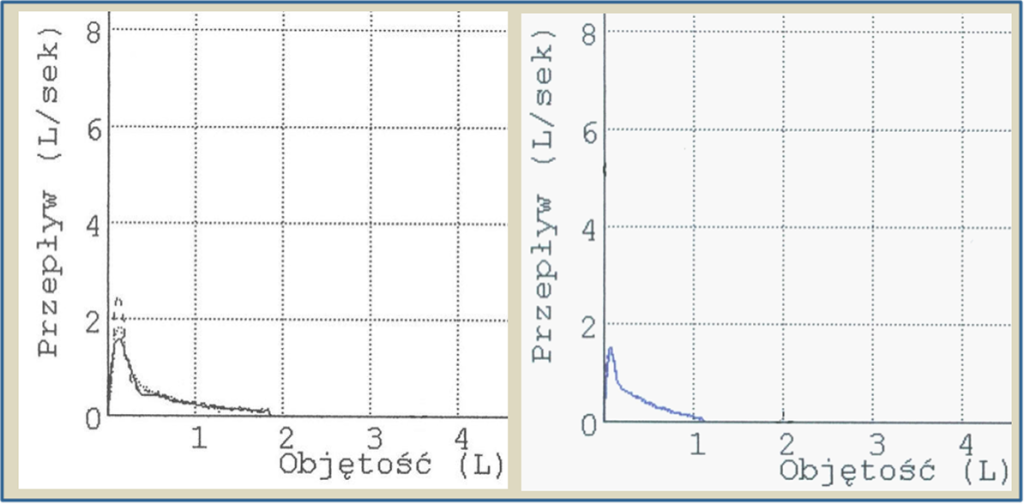
Results forced spirometry of two patients with very severe obstructive pulmonary disease. One of these patients is a living patient, the other - our artificial patient.
B. Mechanical support of the respiratory system
Works related to mechanical support of the respiratory system, both engineering and research, constitute the most important part of the Laboratory's activity. One of our recent achievements is the design and commercialization of a pneumatic respiratory divider (VENTIL) enabling ventilation of each of the lungs in a different way using a single ventilator. VENTIL divides the respiratory mixture delivered by the ventilator to each of the lungs separately according to a given proportion. The activities of our Laboratory, in cooperation with the Institute of Medical Technology and Equipment of the Łukasiewicz Research Network (Ł-ITAM) (currently part of the Cracow Institute of Technology), resulted in the production of 200 pieces of the device and its introduction to the market as a medical product (Ł-ITAM as the manufacturer).
The properties of this divider were used during the COVID-19 pandemic to test the concept of ventilation of two patients using one ventilator, which was a response to the problem of the shortage of ventilators at that time. We conducted both laboratory studies and studies with a large animal model (Zieliński et al., 2022b). The results showed that it is possible to safely ventilate two patients for at least 24 hours. However, such a non-standard type of respiratory therapy is associated with many challenges, such as the appropriate selection of alarms on the ventilator or providing additional monitoring of respiratory parameters for each of the ventilated patients.
Other works related to independent lung ventilation include:
- simulations on a physical model of the bronchial tree printed by a 3D printer (Kramek-Romanowska et al., 2021);
- assessment of the effectiveness of cooperation between the VENTIL device and a ventilator operating in pressure-controlled mode;
- (using the system consisting of a respirator, VENTIL and two artificial patients) studies of pressure disorders in the respiratory tract of one of the patients caused by factors such as the cough of the other.
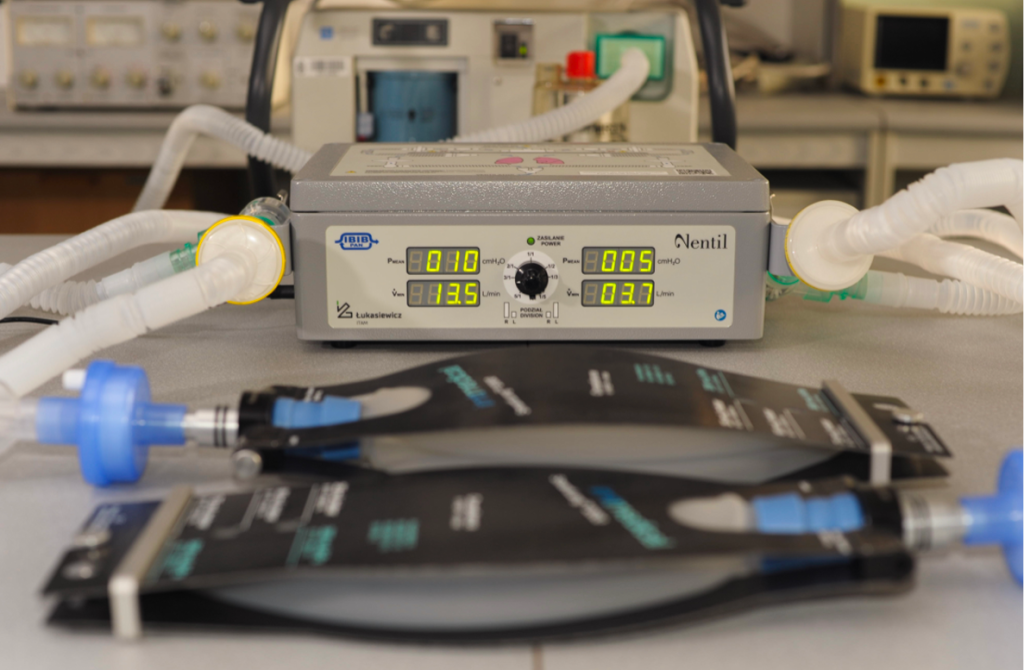
VENTIL – new version produced by Ł-ITAM (now part of KIT)
One of our scientific goals is to expand knowledge about the risk factors for ventilator-induced lung injury (VILI), i.e. the risk of barotrauma, volutrauma, biotrauma or ergotrauma. The results of these studies are intended to indicate which ventilation methods or ventilator settings reduce this risk. VILI may be the result of wrongly selected mechanical ventilation parameters, such as too high maximum inspiratory pressure or too large tidal volume. Due to the viscoelastic properties of the lungs, the risk of VILI also depends on the inspiratory flow rate of the respiratory mixture. This means that inspiratory power, defined as the product of pressure and inspiratory flow, should be a good indicator of the risk of VILI, and the optimal ventilation method should deliver the desired volume of the respiratory mixture to the lungs with minimal inspiratory power. We conduct appropriate simulation studies using our hybrid respiratory system simulator coupled with our own pre-prototype of a ventilator enabling the above-mentioned optimal ventilation.
C. Supporting the diagnosis and respiratory therapy of children
Mechaniczna wentylacja dzieci wiąże się z wysokim ryzykiem urazu płuc. Dotyczy to zwłaszcza niemowląt z niehomogenicznością płuc spowodowaną wrodzoną przepukliną przeponową (CDH), wcześniactwem lub dysplazją oskrzelowo-płucną. Nasze badania ukierunkowane są na optymalizację wentylacji poprzez zindywidualizowane podejście do terapii wentylacyjnej, oparte na wcześniejszej diagnozie stopnia niehomogeniczności wentylacji. W tym celu, można wykorzystać stosunek stałych czasowych obu płuc τ1/τ2 ze względu na jego istotne korelacje z ważnymi parametrami wentylacji: szczytowym ciśnieniem wdechu, średnim ciśnienie w drogach oddechowych, pracy oddechowej i impedancji układu oddechowego (Stankiewicz et al., 2022a; Stankiewicz et al., 2021a).
Studies using a respiratory simulator and a ventilator have revealed risk factors associated with the occurrence of ventilation inhomogeneity in children with unilateral CDH: peak pressures in the more hypoplastic lung with lower compliance may reach dangerously high values at risk of barotrauma, while high auto-PEEP may occur in the other lung. Our results explain why in severe cases of CDH only high-frequency ventilation can be effective and safe (Stankiewicz et al., 2019b). Przedmiotem naszych badań było też porównanie efektywności różnych trybów wentylacji konwencjonalnej i strategii (normokapnii i permisywnej hiperkapnii), w warunkach gdy podatność układu oddechowego dziecka jest zbliżona jest do podatności wewnętrznej układu respiratora, np. u noworodków, wcześniaków (Stankiewicz et al., 2019a).
Symulacje komputerowe dotyczące wpływu wcześniactwa, dysplazji oskrzelowo-płucnej i niehomogeniczności płuc na impedancję układu oddechowego podczas oddychania spontanicznego wykazały również, że podwyższony opór dróg oddechowych i obniżona podatność układu oddechowego u wcześniaków o bardzo niskiej i ekstremalnie niskiej masie urodzeniowej skutkowały istotnym wzrostem impedancji układu oddechowego w stosunku do obserwowanej u niemowląt urodzonych o czasie (Stankiewicz et al., 2017b).
In cooperation with doctors, we also examine the impact of anaesthetics on respiratory and hemodynamic parameters in children during surgery (Kaszyński et al., 2022; Kaszyński et al., 2025). Przewodnim celem tych prac jest ograniczenie użycia leków opioidowych, poprzez zastosowanie leków znieczulających z innej grupy, jak np. lidokaina, która obecnie nie jest rutynowo stosowana u dzieci, w odróżnieniu od osób dorosłych.
As a result of the work, a computer system for the diagnosis and therapy of respiratory disorders in stuttering was also created in the form of a computer game. We obtained two patents for the developed solutions. The results of research on people who stutter indicate that speaking using visual feedback based on the observation of the CO2 exhaled signal significantly improves both the ergonomics of breathing while speaking and the fluency of speech (Stankiewicz et al. 2015).
D. Thoracentesis
Works on analyses and interpretations of physiological phenomena in patients with pleural effusion and changes caused by pleural fluid withdrawal has been carried out in close cooperation with physicians from the Medical University of Warsaw since 2011. The cooperation was initiated by Prof. Krenke’s proposal to build a digital manometer to measure instantaneous values of the pressure in the pleural cavity (Krenke et al., 2011). The next step was to build a complex measuring system, which included both this manometer and three commercial devices (a spirometer adapted by the manufacturer to our needs, a device for transcutaneous blood gas measurement and a cardiac monitor). The system enabled the measurement of many parameters during pleural fluid withdrawal, their synchronization thanks to the use of a mechanical quasi-Dirac delta and recording in a computer.
Pleural fluid causes collapse of a part of the ipsilateral lung (or even the whole lung in the case of massive effusion). After pleural fluid removal, this part may or may not expand. The most important medical problem associated with thoracentesis is the risk of excessive decrease of the pressure in the chest when there is no expansion, and the space occupied by the removed pleural fluid is filled with "nothing". This excessive decrease threatens serious complications, such as, for example, pulmonary edema or rupture of bubbles in other parts of the lung, leading to pneumothorax. Hence the key, although not always appreciated, role of pleural manometry.
Our first and surprising result was the observation suggesting that coughing during thoracentesis, which was usually treated as an obstacle to the procedure or even a reason to interrupt it, does not have to be so (Zielińska-Krawczyk et al., 2015). This was later verified using data from a much larger group of patients (Stecka et al., 2022).
The ability to measure and record accurate instantaneous values of pleural pressure enabled us to discover pleural pressure pulsation (Grabczak et al., 2020) and the analysis of changes in the amplitude of pleural pressure fluctuations related to breathing (Zielińska-Krawczyk et al., 2018). The measurement of other parameters enabled further analyses (Zielińska-Krawczyk et al., 2022).
A significant part of the research related to thoracentesis was the use of our general-purpose virtual patient (Zieliński et al., 2019b; Zieliński et al., 2022) in the interpretation of observed phenomena, sometimes surprising, such as the lack of impact of even massive effusion on arterial blood tensions of O2 and CO2, despite the fact that such effusion significantly disturbs breathing (Stecka et al., 2018; Gólczewski et al., 2025).
Works in this area are still ongoing, both in terms of examining a new group of patients and new analyses and interpretations, e.g. a new explanation of the cause of dyspnea, which is the most frequent and sometimes the only symptom reported by patients with pleural effusion.
Having experience in construction of manometers for biomeasurements, we created a manometer for measuring the pressure in the mouth of infants during suckling. We carried out preliminary studies (Czajkowska et al., 2019).
E. The role of pulse wave reflections in physiology and psychology
Generalized arterial stiffening is a fundamental, physiological effect of circulatory system aging. Increased arterial stiffness causes a decrease in the reflections of flow and pressure waves from peripheral resistance. In extreme cases, so-called impedance matching could occur, i.e. a situation in which the elastic resistance of arteries, low in young people, would increase to such an extent that it would equal the peripheral resistance, which would lead to the disappearance of the reflections. The equalization of the elastic resistance of the arteries with the peripheral resistance can also occur in the case of a significant decrease in the latter, caused, for example, by metabolic vasodilation or antihypertensive drugs.
Although the impedance matching is usually sought in technology, in the case of the circulatory system it would lead to the death of the organism, because due to the lack of the reflections, the entire portion of blood injected by the heart during systole would pass through the microcirculation during this period and, as a result of this, the diastolic pressure would be equal to zero causing ischemia of the organism during diastole. The increase in peripheral resistance in elderly subjects with increased elastic resistance of arteries can therefore be treated as a kind of defense mechanism protecting against the impedance matching, even if it is treated as arterial hypertension.
The magnitude of the reflections, i.e., a kind of distance from the impedance matching, determines the shape of the waveform that is a graph of the blood flow rate in a given place (e.g. in the brachial or carotid artery) as the function of time. We have developed such a mathematical method of quantitatively describing this shape using a single indicator that the value of this indicator is closely correlated with age. Thanks to the appropriate standardization of this indicator using linear regression, its value for the average, healthy and rested subject of a given age is equal to this age; hence the name of the indicator: Waveform Age (WA).
Since approaching the impedance matching is unfavorable for the body, physical activity that requires a decrease in the value of peripheral resistance is limited by processes that stiffen the arteries. If we assume that the physical condition of the body has an impact on mental processes, this limitation also applies to mental activity. Both theoretical analyses and measurements of WA in various groups of people have helped explain many issues, e.g. why antihypertensive treatment of some elderly people leads to depressive behavior and why moderate diastolic hypertension is associated with lower mortality in the elderly (Gólczewski, 2021). Wydaje się jednak, że z poznawczego punktu widzenia najciekawsze są związki WA, tj. wielkości odbić fal pulsu, z właściwościami psychicznymi, w tym z Ilorazem Inteligencji (Gólczewski, 2021) and the so-called brain fog, which is a long-term sequela of COVID-19 (Gólczewski et al., 2024).
F. Spirometry
In the past, one of the leading topics in the Laboratory was research concerned spirometry. This research included both analyses of data obtained from living patients (in cooperation with the Military Institute of Medicine) and theoretical analyses with the use of our virtual patient (Zieliński et al., 2019b; Zieliński et al., 2022a).
The last analysis was related to significant differences (in values of spirometric indices) between databases created at the end of the 20th and in the 21st century. In addition, it turned out that the ECSC spirometric prediction equations, developed on the basis of data collected in Western Europe in the 1970s, were no longer appropriate for the Western European population in the 1990s and for the Polish population in the 21st century, but were appropriate for the Polish population in the 1990s. These comparisons and comparisons with changes in life expectancy in Poland and Western European countries suggested the need for periodic updating of the prediction equations as the socio-economic development of a given population increases (Chciałowski et al., 2019).
Using our artificial patient, we showed how altered elastic properties of the lungs can falsify the diagnosis of obstructive diseases if only the results of a spirometric test are relied on (Pałko et al., 2020).
Awards
- Prix Galien’2012 Poland (Gold medal in the category “Innovative research work”) for: Original artificial respiratory and circulatory patient
- Golden Scalpel’2018 (7th place) for: Application of electronic pleural manometry in high-volume thoracentesis, qualification for pleurodesis and learning about pathophysiological processes occurring in the pleural cavity.
- Polish Product of the Future’2021 (Nagroda w kategorii „Produkt Przyszłości Instytucji Szkolnictwa Wyższego i Nauki”) za: VENTIL – innowacyjne urządzenie do niezależnej wentylacji płuc
- Economic Award of the President of the Republic of Poland’2021 (in the category “Research + Development”)
Cooperation with external institutes:
- Warsaw Medical University (Poland)
- Military Institute of Medicine (Poland)
- Institute of Medical Technology and Equipment ITAM (Poland)
- Institute of Clinical Physiology CNR (Italy)
- Cardiac Surgery, Department of Cardiovascular Sciences, University of Leuven (Belgium)
- Bydgoszcz University of Science and Technology (Poland)
- Warsaw University of Life Sciences (Poland)
Latest external Projects:
- Research project NCN OPUS Nr 2012/05/B/NZ5/01343 „Ventilation, gas exchange and cardiac function in relation to intrapleural pressure changes in patients undergoing therapeutic thoracentesis”.
- Research project NCN OPUS Nr 2019/35/B/NZ5/02531 „Large volume thoracentesis with pleural pressure measurements for evaluation of new pathophysiological aspects of pleural effusion”.
- Research project NCBR LIDER Nr UMO-LIDER/19/0107/L-8/16/NCBR/2017 „Independent lung ventilation and inhalation system”.
- Research project NCN SONATA Nr 2021/43/D/ST7/01912 „ Assessment of the effectiveness of independent lung ventilation system working with a ventilator in the pressure-controlled modes”.
- Projekt badawczy NCN MAESTRO Nr 2023/50/A/ST7/00498 „Development of optimal lung ventilation to minimise the risk of ventilator-induced lung injury (VILI)”.
- Bilateral project within the collaboration between PAS and FWO „A cardiovascular simulator for medical device testing”.
Latest patents:
European:
- Darowski M, Kozarski M, Stankiewicz B, Michnikowski M, Pałko KJ, Zieliński K. Volume divider and method of respiratory gas division. EP3154617 (2020).
Polish:
- Darowski M, Kozarski M. Method and system for controlling the volume of the patient's inspiratory gas mixture delivered by splitting the inspiratory gas mixture of a ventilator to at least one of two respiratory tracks from a single ventilator, and a related method and system for multi-position ventilation of the respirator's inspiratory gas mixture from a single ventilator. PL245364 (2024).
- Darowski M, Kozarski M. Fluid-electric impedance transformer and method of power balancing in the fluid-electric impedance transforme. PL246699 (2024).
- Darowski M, Kozarski M. Module system of multi-station patient ventilation. PL244255 (2023).
- Darowski M, Kozarski M. Breathing gas stream measuring head. PL244335 (2023).
- Kozarski M, Darowski M, Zieliński K, Kozarski Ł. Hybrid interface for testing of a balloon pump. PL237195 (2020).
- Kozarski M, Darowski M, Zieliński K. Anemometric differential pressure gas stream sensor. PL226850 (2018).
- Kozarski M, Darowski M, Zieliński K. Method for measuring mechanical parameters of respiratory system. PL 229751 (2018).
- Kozarski M, Darowski M, Zieliński K. Capacitive displacement sensor. PL226850 (2017).
- Kozarski M, Darowski M, Pałko KJ, Zieliński K. Method and apparatus for supporting a patient's breath. PL227710 (2017).
- Kozarski M, Darowski M, Pałko KJ, Zieliński K. Dosing and measuring respiratory gas mixer. PL223585 (2016).
- Kozarski M, Darowski M, Pałko KJ, Zieliński K. Inductance sensor. PL 223714 (2016).
- Kozarski M, Darowski M, Pałko KJ, Zieliński K. Two-plunger volumeter. PL223960 (2016).
- Kozarski M, Darowski M, Zieliński K, Pałko KJ, Górczyńska K. Hybrid system for testing rotating pumps. PL 223018 (2015).
- Darowski M, Kozarski M, Stankiewicz B, Michnikowski M, Pałko KJ, Zieliński K. Gas mixture volume automatic divider. PL 221432 (2015).
- Kozarski M, Darowski M, Zieliński K. Intubation pressure sensor. PL221385 (2015).
Publications since 2015:
- Chciałowski A, Gólczewski T. (2019). Spirometry: A need for periodic updates of national reference values. Adv Exp Med Biol. 1222:1-8. https://doi.org/10.1007/5584_2019_432
- Colasanti S, Piemonte V, Devolder E, Zieliński K, Vandendriessche K, Meyns B, Fresiello L. (2021). Development of a computational simulator of the extracorporeal membrane oxygenation and its validation with in vitro measurements. Artif Organs 45, 399–410. https://doi.org/10.1111/aor.13842
- Czajkowska M, Fonfara A, Królak-Olejnik B, Michnikowski M, Gólczewski T. (2019). The impact of early therapeutic intervention on the central pattern generator in premature newborns – a preliminary study and literature review. Developmental period medicine, 23(3), 178–183. https://doi.org/10.34763/devperiodmed.20192303.178183
- Fresiello L, Zieliński K. (2020). Hemodynamic Modelling and Simulations for Mechanical Circulatory Support, in: Karimov, J.H., Fukamachi, K., Starling, R.C. (Eds.), Mechanical Support for Heart Failure : Current Solutions and New Technologies. Springer International Publishing, Cham, pp. 429–447. https://doi.org/10.1007/978-3-030-47809-4_26
- Fresiello L, Muthiah K, Goetschalck K, Hayward C, Rocchi M, Bezy M, Pauls JP, Meyn, B, Donke, DW, Zieliński K. (2022a). Initial clinical validation of a hybrid in silico-in vitro cardiorespiratory simulator for comprehensive testing of mechanical circulatory support systems. Front Physiol 13, 967449. https://doi.org/10.3389/fphys.2022.967449
- Fresiello L, Najar A, Brynedal Ignell N, Zieliński K, Rocchi M, Meyns B, Perkins IL. (2022b). Hemodynamic characterization of the Realheart® total artificial heart with a hybrid cardiovascular simulator. Artif Organs 46, 1585–1596. https://doi.org/10.1111/aor.14223
- Gólczewski T, Stecka A M, Michnikowski M, Grabczak E M, Korczyński P, Krenke R. (2017). The use of a virtual patient to follow pleural pressure changes associated with therapeutic thoracentesis. Int J Artif Organs, 40(12), 690–695. https://doi.org/10.5301/ijao.5000636
- Gólczewski T. (2021) Arterial blood flow waveform shapes – their original quantification and importance in chosen aspects of physiology and psychology: A review. Biocybern Biomed Eng, 41:1418-1435 https://doi:10.1016/j.bbe.2021.04.007
- Gólczewski T, Plewka K, Michnikowski M, Chciałowski A. (2024). Correlations between vascular properties and mental dysfunctions in long-COVID-19 support the vascular depression hypothesis. Biocybern Biomed Eng, 44(3):461-469. https://doi.org/10.1016/j.bbe.2024.07.001
- Gólczewski T, Stecka AM, Grabczak EM, Michnikowski M, Zielińska-Krawczyk M, Krenke R. (2025). Hemidiaphragm work in large pleural effusion and its insignificant impact on blood gases: a new insight based on in silico study. Front Physiol, 16:1539781 https://doi:10.3389/fphys.2025.1539781
- Grabczak EM, Michnikowski M, Styczynski G, Zielinska-Krawczyk M, Stecka AM, Korczynski P, Zielinski K, Palko KJ, Rahman NM, Golczewski T, Krenke R. (2020). Pleural pressure pulse in patients with pleural effusion: A new phenomenon registered during thoracentesis with pleural manometry. J Clin Med, 9(8), 2396. https://doi.org/10.3390/jcm9082396
- Kaszyński M, Stankiewicz B, Pałko KJ, Darowski M, Pągowska-Klimek I.(2022) Impact of lidocaine on hemodynamic and respiratory parameters during laparoscopic appendectomy in children. Sci Rep 18;12(1):14038. https://doi.org/10.1038/s41598-022-18243-3
- Kaszyński M, Kuczerowska A, Pietrzyk J, Sawicki P, Witt P, Stankiewicz B, Darowski M, Pągowska-Klimek I. (2025). Influence of intravenous lidocaine infusion on haemodynamic response to tracheal intubation and metabolic-hormonal responses during laparoscopic procedures in children: a randomised controlled trial. BMC Anesthesiol 25;23. https://doi.org/10.1186/s12871-024-02885-z
- Kozarski M, Suwalski P, Zieliński K, Górczyńska K, Szafron B, Pałko KJ, Smoczyński R, Darowski M. (2015). A hybrid (hydro-numerical) circulatory model: investigations of mechanical aortic valves and a numerical valve model. Bull Pol Acad Sci Tech Sci 63, 605–612. https://doi.org/10.1515/bpasts-2015-0071
- Kramek-Romanowska K, Stecka AM, Zieliński K, Dorosz A, Okrzeja P, Michnikowski M, Odziomek M. (2021). Independent Lung Ventilation-Experimental Studies on a 3D Printed Respiratory Tract Model. Materials (Basel) 14, 5189. https://doi.org/10.3390/ma14185189
- Krenke R, Guć M, Grabczak E M, Michnikowski M, Pałko K J, Chazan R, Gólczewski T. (2011). Development of an electronic manometer for intrapleural pressure monitoring. Respiration, 82(4), 377–385. https://doi.org/10.1159/000328718
- Pałko KJ, Gólczewski T, Kozarski M, Stankiewicz B, Darowski M. (2020). A New Method and Device for Differentiating Elastic and Resistive Properties of the Respiratory System. In: Korbicz, J., Maniewski, R., Patan, K., Kowal, M. (eds) Current Trends in Biomedical Engineering and Bioimages Analysis. PCBEE 2019. Advances in Intelligent Systems and Computing, vol 1033. Springer, Cham. https://doi.org/10.1007/978-3-030-29885-2_4
- Pałko KJ, Kołodziej D, Darowski M. (2024) Lung divisions for models of cardiopulmonary interaction – preliminary tests. Pol J Med Phys Eng 30(2), 52-68. https://doi.org/10.2478/pjmpe-2024-0007
- Pasledni R, Zieliński K. (2022). Hybrid Cardiovascular Simulator – An Application for the Mechanical Assistance by an Intra-aortic Balloon Pump, in: Pijanowska, D.G., Zieliński, K., Liebert, A., Kacprzyk, J. (Eds.), Biocybernetics and Biomedical Engineering – Current Trends and Challenges. Springer International Publishing, Cham, pp. 98–107. https://doi.org/10.1007/978-3-030-83704-4_10
- Pasledni R, Kozarski M, Mizerski JK, Darowski M, Okrzeja P, Zieliński K. (2024). The hybrid (physical-computational) cardiovascular simulator to study valvular diseases. J Biomech. 170, 112173. https://doi.org/10.1016/j.jbiomech.2024.112173
- Rocchi M, Fresiello L, Meyns B, Jacobs S, Gross C, Pauls JP, Graefe R, Stecka AM, Kozarski M, Zieliński K. (2021). A Compliant Model of the Ventricular Apex to Study Suction in Ventricular Assist Devices. ASAIO J 67, 1125–1133. https://doi.org/10.1097/MAT.0000000000001370
- Stankiewicz B, Zieliński K, Darowski M, Michnikowski M (2015): EtCO2-based biofeedback method of breath regulation increases speech fluency of stuttering people. Arch Acoust 40(4):469-474.
- Stankiewicz B, Pałko K J, Darowski M, Zieliński K, Kozarski M. (2017a). A new infant hybrid respiratory simulator: preliminary evaluation based on clinical data. Med Biol Eng Comput. 55, 1937–1948 DOI:10.1007/s11517-017-1635-9.
- Stankiewicz B, Darowski M, Pałko KJ. (2017b). Influence of Preterm Birth, BPD and Lung Inhomogeneity on Respiratory System Impedance – Model Studies. In: Augustyniak P, Maniewski R, Tadeusiewicz R (eds.), Recent Developments and Achievements in Biocybernetics and Biomedical Engineering 201 (455934_1_En, Chapter 6). PCBBE 2017. Advances in Intelligent Systems and Computing, vol. 647. Springer.
- Stankiewicz B, Rawicz M, Darowski M, Zieliński K, Kozarski M, Chwojnowski A. (2017c): Use of siliconised infant endotracheal tubes reduces work of breathing under turbulent flow. Biocybern Biomed Eng 37(1):59-65. DOI:10.1016/j.bbe.2016.11.002.
- Stankiewicz B, Pałko KJ, Darowski M, Kozarski M. (2019a). How to ventilate preterm infants with lung compliance close to circuit compliance – real-time simulations on an infant hybrid respiratory simulator. Med Biol Eng Comput 58, 357–37. https://doi.org.10.1007/s11517-019-02089-5.
- Stankiewicz B, Pałko KJ, Darowski M, Kozarski M and Górczyńska K. (2019b). Challenges with conventional ventilation of infants with inhomogeneous lungs. In: Korbicz J, Maniewski R, Patan K, Kowal M (eds): Current Trends in Biomedical Engineering and Bioimages Analysis. PCBEE 2019. Advances in Intelligent Systems and Computing, vol. 1033:224-234. Springer, Cham. https://doi.org/10.1007/978-3-030-29885-2_21.
- Stankiewicz B, Mierzewska-Schmidt M., Górczyńska K, Baranowski A., Kozarski M, Darowski M (2021). Ventilation inhomogeneity in CDH infants – A new attitude within a simulation study, Biocybern Biomed Eng, 41(4):1378-1389. https://doi.org/10.1016/j.bbe.2021.08.002.
- Stankiewicz B, Mierzewska-Schmidt M, Pałko KJ, Baranowski A, Darowski M, Kozarski M. (2022). A new method of ventilation inhomogeneity assessment based on a simulation study using clinical data on congenital diaphragmatic hernia cases. Sci Rep 12:22635. https://doi.org/10.1038/s41598-022-27027-8
- Stecka AM, Gólczewski T, Grabczak EM, Zieliński K, Michnikowski M, Zielińska-Krawczyk M, Korczyński P, Krenke R. (2018). The use of a virtual patient to follow changes in arterial blood gases associated with therapeutic thoracentesis. Int J Artif Organs, 41(11), 690–697. https://doi.org/10.1177/0391398818793354
- Stecka A M, Grabczak E M, Michnikowski M, Zielińska-Krawczyk M, Krenke R, Gólczewski T. (2022). The impact of spontaneous cough on pleural pressure changes during therapeutic thoracentesis. Sci Rep, 12(1), 11502. https://doi.org/10.1038/s41598-022-15480-4
- Zielinska-Krawczyk M, Michnikowski M, Grabczak E M, Palko K J, Korczynski P, Golczewski T, Krenke R. (2015). Cough during therapeutic thoracentesis: friend or foe?. Respirology 20(1), 166–168. https://doi.org/10.1111/resp.12426
- Zielinska-Krawczyk M, Grabczak E M, Michnikowski M, Zielinski K, Korczynski P, Stecka A, Golczewski T, Krenke R. (2018). Patterns of pleural pressure amplitude and respiratory rate changes during therapeutic thoracentesis. BMC Pulm Med 18(1), 36. https://doi.org/10.1186/s12890-018-0595-7
- Zielinska-Krawczyk M, Stecka AM, Grabczak EM, Michnikowski M, Zieliński K, Korczynski P, Gólczewski T, Krenke R. (2022). Impact of therapeutic thoracentesis and pleural pressure changes on breathing pattern, dyspnea, lung function, and arterial blood gases. Pol Arch Intern Med. 132(4):16185. https://doi:10.20452/pamw.16185
- Zieliński K, Darowski M, Kozarski M, Ferrari G. (2016). The need for hybrid modeling in analysis of cardiovascular and respiratory support. Int J Artif Organs 39, 265–271. https://doi.org/10.5301/ijao.5000513
- Zieliński K, Okrzeja P, Stecka A, Kozarski M, Darowski M. (2019a). A Hybrid Cardio-Pulmonary Simulation Platform—An Application for Extracorporeal Assist Devices. In: Lhotska, L., Sukupova, L., Lacković, I., Ibbott, G.S. (eds) World Congress on Medical Physics and Biomedical Engineering 2018. IFMBE Proceedings, vol 68/1. Springer, Singapore. https://doi.org/10.1007/978-981-10-9035-6_130
- Zieliński K, Stecka A, Gólczewski T. (2019b). VirRespir—An Application for Virtual Pneumonological Experimentation and Clinical Training. In: Lhotska, L., Sukupova, L., Lacković, I., Ibbott, G.S. (eds) World Congress on Medical Physics and Biomedical Engineering 2018. IFMBE Proceedings, vol 68/1. Springer, Singapore. https://doi.org/10.1007/978-981-10-9035-6_129
- Zieliński K, Górczyńska K, Kozarski M, Okrzeja P, Darowski M, Ferrari G. (2020). A Novel Real-Time Computer Model of the Coronary System Including a Physiological Feedback Between the Left Ventricular Muscles and Coronary Perfusion, in: Korbicz, J., Maniewski, R., Patan, K., Kowal, M. (Eds.), Current Trends in Biomedical Engineering and Bioimages Analysis. Springer International Publishing, Cham, pp. 265–276. https://doi.org/10.1007/978-3-030-29885-2_24
- Zieliński K, Gólczewski T, Kozarski M, Darowski M. (2022a). Virtual and Artificial Cardiorespiratory Patients in Medicine and Biomedical Engineering. Membranes, 12(6), 548. https://doi.org/10.3390/membranes12060548
- Zieliński K, Lisowska B, Siewruk K, Sady M, Ferenc K, Barwijuk M, Olszewski J, Anusz K, Jabłoński A, Gajewska M, Okrzeja P, Michnikowski M., Pijanowska, D.G., Pluta, K., Remiszewska, E., Darowski M, Zabielski R, Liebert A., Kramek-Romanowska, K., Stecka A, Kozarski M, Pasledni R, Gajewski Z, Ładyżyński P. (2022b). Automatic air volume control system for ventilation of two patients using a single ventilator: a large animal model study. Sci Rep 12, 22591. https://doi.org/10.1038/s41598-022-26922-4
