History
The establishment of the Institute of Biocybernetics and Biomedical Engineering (IBIB PAN) as of October 15, 1975 was preceded by a series of works carried out by research teams at the Departments and Scientific Institutes of the Polish Academy of Sciences, carried out under the direct as well as indirect leadership of Professor Maciej Nałęcz. In the Department of Electrical Engineering of the Polish Academy of Sciences, established in 1954 on the initiative of Prof. Pawel Nowacki, Maciej Nałęcz, M.Sc., who was appointed head of the Department, organized a research team, the members of which for many years to come participated in the research teams from which the IBIB of the Polish Academy of Sciences was formed. In 1959, the aforementioned Department of Electrical Engineering of the Polish Academy of Sciences was incorporated into the Institute of Fundamental Technological Problems of the Polish Academy of Sciences.
The subject matter of this Department concerned semiconductor, magnetic and mechanical sensors and converters of various physical quantities to electrical signals, mainly for the measurement of these quantities, and also - magnetic amplifiers for the control of power generators in power plants. The Department of Electrical Engineering PAS and the Department of Automation PAS, which was an independent unit in the years 1954-1962, as well as the Department of Analogy IPPT PAS and part of the Department of Communication Theory IPPT PAS became the basis for the Institute of Automation PAS (IA PAS), established in 1962, with its headquarters in Warsaw at 55 Krajowa Rada Narodowa St. The director of IA PAS was Prof. Maciej Nałęcz. The employees of this Institute in the first period of its activity were mainly graduates of the Electrical and Electronics (formerly Communications) Faculties of the Warsaw University of Technology, including - Dr. Andrzej Straszak and Prof. Roman Kulikowski, representing control theory.
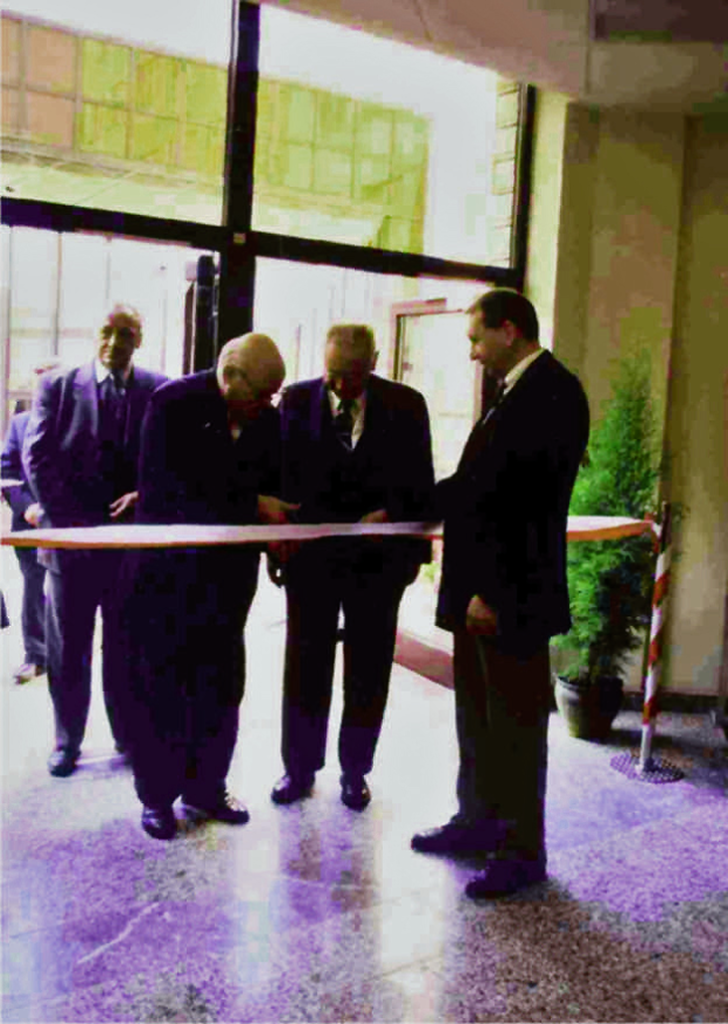
Szybki rozwój i różnicowanie się tematyki badawczej na świecie w tamtym okresie w zakresie technologii materiałów, w tym półprzewodników, cybernetyki, automatyki, teorii systemów, technik komputerowych itp., połączony z tworzeniem interdyscyplinarnych kierunków badawczych, był przyczyną powstawania i rozwoju nowych zespołów badawczych, w tym zespołów interdyscyplinarnych. Następstwem tego była konieczność reorganizacji instytucji badawczych. Nastąpiło to również w Polsce, czego wyrazem było powstawanie i reorganizacja instytutów PAN. W 1971 r., z Instytutu Automatyki PAN, został utworzony Instytut Cybernetyki Stosowanej PAN (ICS PAN), którego dyrektorem został Prof. Maciej Nałęcz. Tematyka badań prowadzonych w ICS PAN dotyczyła: (1) metod i urządzeń pomiarowych różnych wielkości mechanicznych, elektrycznych, magnetycznych i optycznych; (2) wykorzystania uzyskanych sygnałów pomiarowych dla różnych celów, w tym biomedycznych, głównie z wykorzystaniem metod elektrycznych; (3) komputerowych metod i urządzeń do przetwarzania i analizy sygnałów i obrazów biomedycznych; (4) metod cybernetycznych i (5) bioniki.
At the same time, in 1971-1975, extensive interdisciplinary research was undertaken in Poland, within the framework of the nationwide nodal problem 06.6.1 "Research on the application of new physical phenomena and technologies to the construction of measuring instruments and automation components, and the development and implementation for small-scale production of scientific and research apparatus." ICS PAS has been designated as the coordinating unit in this case, and Prof. Maciej Nalecz has been appointed as the head of this nodal problem.
Undertaking research on such an extensive topic required taking an interest in it and attracting research teams and employees with relevant specialties from numerous institutions. In addition to the aforementioned graduates of the Faculties of Electrical Engineering and Electronics of the Warsaw University of Technology, graduates of universities with other specialties, such as from the Faculties of Precision Mechanics (now Mechatronics), Chemical Engineering and Chemical and Process Engineering of the Warsaw University of Technology, as well as - from the Medical Academies, also participated in the implementation of the tasks of nodal problem 06.6.1.
An important factor stimulating the dissemination of new scientific disciplines in the country was the establishment of the Committee on Biocybernetics and Biomedical Engineering of the Polish Academy of Sciences in 1972, the chairman of which, as a result of the election, became Prof. Maciej Nałęcz and held this position until 2007.
In 1973, in connection with the slogan of creating "large economic organizations" (WOGs) promoted by the country's political authorities of the time, the Institute of Applied Cybernetics of the Polish Academy of Sciences and selected research teams from the Institute of Philosophy and Sociology of the Polish Academy of Sciences and other units dealing with information technology were formed from the merger of the Institute of Organization and Management (IOiK), as a scientific unit subordinate to the Polish Academy of Sciences and the Ministry of Science, Higher Education and Technology.
Within the framework of IOiK PAN and MNSWiT, of which Prof. Andrzej Straszak became Director, the research previously conducted at ICS PAN was continued, preferred due to the political and economic needs of the time. In particular, this included: the theory of control of large systems, the theory and methods of work organization, the theory and basis of operation of multicomputer information systems, etc. Within this Institute, the Biocybernetics and Biomedical Engineering Center (OBiIB), established on the initiative of Prof. Maciej Nałęcz, who became Head of this Center, continued research previously conducted at ICS PAS in the fields of biocybernetics and biomedical engineering, as well as measurement and control systems. This prevented the reduction of research at IOiK from this area. The institute, established in this way for political reasons, lasted only two years.
Based on the scientific staff working at the Center for Biocybernetics and Biomedical Engineering of the IOiK PAN and the MNSzWiT, in January 1975, a team led by Prof. Maciej Nałęcz prepared a proposal for the establishment of the IBIB PAN. An important rationale for the establishment of this interdisciplinary Institute in Poland was to base its activities on the integration of distant fields of knowledge - biology and medicine on the one hand, and science and technical sciences with its research, measurement and mathematical methods on the other. In the leading countries of the world at that time, numerous institutions were established to conduct research in the aforementioned field. There were journals published on the subject. The IBIB of the Polish Academy of Sciences began its activities on October 15, 1975 - on the basis of the Resolution of the Presidium of the Polish Academy of Sciences of July 15, 1975. The main organizer of the Institute and its first Director was Professor Maciej Nałęcz. Favorable conditions for the development of the Institute, as well as the new discipline in Poland, were also provided by various initiated events, which became the basis for long-term activity, including the organization of the National Scientific Conferences on Biocybernetics and Biomedical Engineering (since 1976) and the publication of the quarterly Biocybernetics and Biomedical Engineering (since 1980), as well as the construction of the Institute's new headquarters at 4 Prince Trojden Street in Warsaw. An important role in the aforementioned organizational and research activities was played, mainly in the initial period of IBIB PAN's activity, by Prof. Maciej Nałęcz's closest collaborators, including later professors Stanisław Topiński, Ignacy Zawicki, Władysław Torbicz, Andrzej Weryński, Roman Maniewski, Zbigniew Dunajski, Wojciech Piątkiewicz, Marek Darowski, Wojciech Zmysłowski and Jan Wójcicki.
IBIB PAN jest największą placówką w Polsce prowadzącą badania dotyczące dyscypliny inżynierii biomedycznej. Jako pierwszy w Polsce, uzyskał uprawnienia do nadawania stopni doktora (1983 r.) i doktora habilitowanego (1987 r.) w dziedzinie nauk technicznych – w dyscyplinie biocybernetyka i inżynieria biomedyczna. Aktualnie nazwy te to: dziedzina nauk inżynieryjno-technicznych i dyscyplina inżynieria biomedyczna. IBIB PAN, od jego powołania, oprócz swojej działalności statutowej, włączył się aktywnie do działalności mającej na celu rozwój inżynierii biomedycznej w kraju. Od powstania w 1988 r. Międzynarodowego Centrum Biocybernetyki PAN (MCB), które jest administracyjnie połączone z IBIB PAN, i którego dyrektorem przez 21 lat był Prof. Maciej Nałęcz, Instytut rozwinął bliskie kontakty z wieloma placówkami i organizacjami zagranicznymi. Ułatwiało to międzynarodową współprace naukową nie tyko Instytutowi, ale również innym zespołom badawczym z Polski. Dobre obecnie warunki lokalowe, w tym pokoje hotelowe w siedzibie Instytutu ułatwiają organizowanie seminariów i konferencji naukowych – krajowych i międzynarodowych.
Calendar of events
| 1952 | Establishment of the Polish Academy of Sciences |
| 1954 | Establishment of the Department of Electrical Engineering of the Polish Academy of Sciences Head: Prof. Paweł Nowacki |
| 1957 | Transfer of the Department of Electrical Engineering to IPPT PAN Head: Dr. Maciej Nałęcz, Eng. |
| 1962 | Establishment of the Institute of Automation, Polish Academy of Sciences Director: Prof. M. Nałęcz Establishment of the Laboratory of Bionics Head: Prof. Ryszard Gawronski |
| 1972 | Establishment of the Committee on Biocybernetics and Biomedical Engineering Chairman: Prof. Maciej Nałęcz |
| 15 July 1975 | Resolution of the Presidium of the Polish Academy of Sciences dated July 15, 1975 on the establishment of the Institute of Biocybernetics and Biomedical Engineering of the Polish Academy of Sciences. |
| 8 August 1975 | Decision of the Prime Minister dated August 8, 1975 approving the resolution of the Presidium of the Polish Academy of Sciences |
| 1975 | Establishment of the Institute of Biocybernetics and Biomedical Engineering of the Polish Academy of Sciences first Director: Prof. Maciej Nałęcz |
| 1983 | Acquisition of the right to confer the doctoral degree |
| 1987 | Obtaining the right to confer the postdoctoral degree |
| 1988 | Establishment of the INTERNATIONAL CENTRE OF BIOCYBERNETICS PAS first Director: Prof. Maciej Nałęcz |
Prof. Dr.-Ing. Maciej Nałęcz
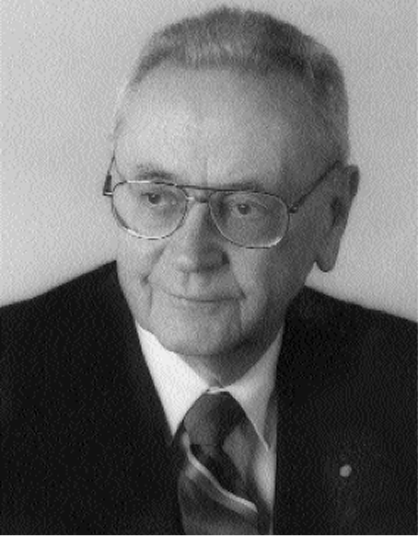
Prof. Maciej Nalecz (1922-2009) spent 2 years 1927-1930 in the USA. After returning to Poland, he attended school in Bialystok, and then in Warsaw at the Władysław IV Gymnasium and High School. During the German occupation, he graduated from the Secondary School of Electrical Engineering, where professors from the Warsaw University of Technology were his lecturers. He then studied at the State Technical College. In 1948, he spent three months in the US, where he participated in the Foreign Students Summer Project of the Massachusetts Institute of Technology, working there on his master's thesis on the effects of selected electromagnetic field gradients on plant growth, which he defended in 1949 at the Warsaw University of Technology. This was Prof. M. Nalecz's first contact with the problems of bioengineering. Prof. Nalecz's scientific activity can be divided into three periods: 1949 - 1962 - research in electrical engineering; 1962-72 - research in automation; since 1972 - research in biocybernetics and biomedical engineering.
Prof. Maciej Nałęcz's contribution to the development of the scientific staff - beginnings
From the beginning of his scientific activity at the Department of Electrical Engineering of the Polish Academy of Sciences, Prof. M. Nalecz gathered around him a group of colleagues, mostly graduates of the Electrical Faculty of Warsaw University of Technology, some of them his students, from the Department of Electrical Metering of the Warsaw University of Technology, of which he was an employee. In the early days and for many years, the above-mentioned academics worked with Prof. M. Nałęcz.
The subject of Prof. M. Nałęcz's doctoral dissertation, whose supervisor was Prof. Pawel Nowacki, included a theoretical description of the operation of a current transformer with deviation compensation by means of an additional magnetic field flux introduced into its core. Current transformers are used in current measurement in power grids.
In the early days, Prof. M. Nałęcz's research work at the Department of Electrical Engineering of the Polish Academy of Sciences, later incorporated into the IPPT PAN, as well as at the Institute of Automation of the Polish Academy of Sciences, concerned the use of physical phenomena, mainly from the field of electrical engineering, for the construction of measurement and control elements for automation. Together with Prof. Jan J. Kulikowski, an even harmonic magnetometer was developed for measuring very low magnetic field intensities. Such magnetometers were used to monitor magnetic fields caused by ships, for which the authors received an award from the Unification of the Shipbuilding Industry.
Prof. Maciej Nałęcz's contribution to the development of scientific personnel - biomedical engineering
In 1972, the Committee on Biocybernetics and Biomedical Engineering of the Polish Academy of Sciences was established, with Prof. M. Nalecz as chairman, and he became a full member of the Polish Academy of Sciences in 1974. In 1975, the Institute of Biocybernetics and Biomedical Engineering of the Polish Academy of Sciences was established, of which Prof. M. Nałęcz became Director - a position he held until December 1992. Being the Director of the IBIB of the Polish Academy of Sciences, Prof. M. Nałęcz, in addition to scientific activity, carried out organizational and scientific activities of national and international scope.
Prof. Maciej Nałęcz had a great influence on the selection and subject matter of the scientific staff, as well as its development and acquisition of scientific degrees, in the period before the establishment of IBIB PAN, and after its establishment in the period of formation of the Institute's research subject matter. Having good scientific contacts at home and abroad, resulting from his function in the Polish Academy of Sciences and in scientific committees in Poland and abroad, as well as due to his stay in the USA during his early youth and, in addition - great ease in establishing contacts with other people, he could use the facts in carrying out the activities presented above. It can be assumed that Prof. M. Nałęcz had a clear goal of developing science in Poland after the destruction of the country, including science, caused by World War II.
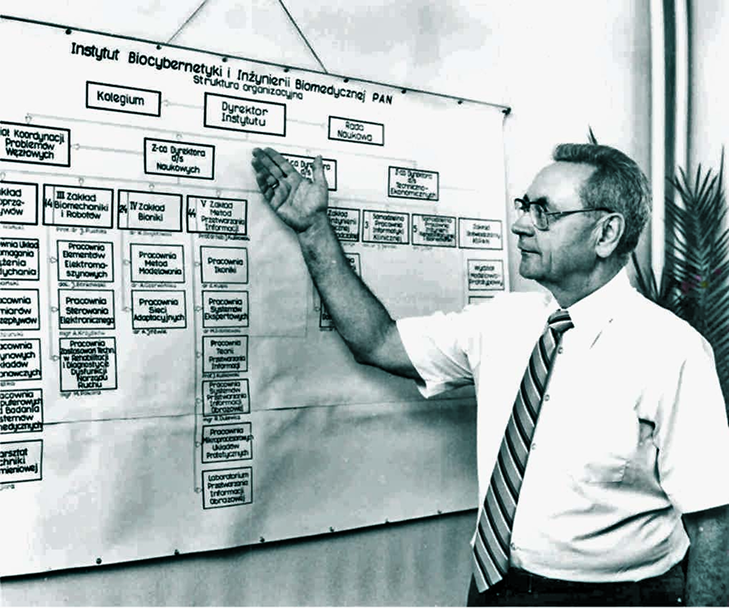
International activities of Prof. Maciej Nalecz
Prof. M. Nalecz has been to many foreign scientific centers, mainly in the USA, as a "visiting professor." In 1991-1992, he participated in the prestigious "Scholar in Residence" program at the Fogarty International Center, National Institutes of Health, Bethesda. In 1994, at the NIH Campus, Prof. M. Nalecz co-organized the first Contribution of Biomedical Engineering to Biology and Medicine conference (75 foreign lecturers), received with great interest by the international scientific community.
Prof. Maciej Nałęcz made a major contribution to the establishment of the International Center of Biocybernetics in 1988 and to its activities, exchange of scientific information, improvement of professional skills and promotion of research results through the organization of seminars, conferences and training in the following research areas: biosystems, bioprocessing, artificial internal organs, biomechanics and bioinformatics. Members of the ICB include scientific organizations from the following countries: Belgium, Bulgaria, China, Estonia, France, Georgia, Italy, Poland, Romania, Ukraine, and Vietnam, as well as "ad personam" members from several countries.
Governing bodies of IBIB PAN
According to the Statutes of IBIB PAN, the Institute's governing bodies are the Director and the Scientific Council. The Director appoints his deputies after consultation with the Scientific Council. The full composition of the Directorate and the Presidium of the Scientific Council since the establishment of the Institute is presented below (in a tabular and graphical presentation.
| Period | Directors |
|---|---|
| 15.10-1.11.1975 | Interim administrator: Prof. Dr. Władysław Torbicz |
| 1.11.1975-1.01.1993 1.11.1978-01.1993 1.01.1976-15.04.1994 1.11.1978-1.07.1982 1.01.1976-31.05.1981 1.09.1988-1.01.1993 | Director: Prof. Dr. Ing. Maciej Nałęcz Deputy Director for Scientific Affairs: Prof. Dr. Andrzej Weryński Deputy Director for General Affairs: Prof. Dr. Ing. Stanisław Topiński Deputy Dir. for Technical Affairs: Associate Professor Zbigniew Wański Deputy Director of Economic Affairs: Z. Karpovich, M.Sc. Deputy Director for Technical and Economic Affairs: Dr.-Ing. M. Cieślak |
| 1.01.1993-31.01.2007 1.01.1976-15.04.1994 15.04.1994–31.01.2007 1.1.1993-31.08.1997 1.10.1997-31.01.2007 | Director: Prof. Dr. Andrzej Weryński Deputy Director for Scientific Affairs: Prof. Dr. Ing. Władysław Torbicz Deputy Director for General Affairs: Dr. Jan Wójcicki Deputy Director for Technical and Economic Affairs: Dr.-Ing. M. Cieślak Deputy Director for Technical and Economic Affairs: Dariusz Pisarski, M.Sc. |
| 31.01.2007–30.12.2013 30.12.2013–30.09.2014 31.01.2007–30.09.2014 31.01.2007–30.09.2014 31.01.2007–31.12.2015 | Director: Prof. Dr.-Ing. Jan Maria Wójcicki Acting Director: Prof. Dr. Marek Darowski Deputy Director for Scientific Affairs: Prof. Dr. Marek Darowski Deputy Director for General Affairs: Prof. nadzw. dr hab. inż. Piotr Ładyżyński Deputy Director for Technical and Economic Affairs: Dariusz Pisarski, MA |
| 30.09.2014-30.09.2022 30.09.2014–30.09.2018 30.09.2014–30.09.2018 30.09.2014–30.09.2018 30.09.2018–30.09.2022 30.09.2018–30.09.2022 | Director: Prof. Adam Liebert, PhD, DSc Deputy Director for Scientific Affairs: Prof. Jacek Waniewski, PhD, DSc Deputy: Dir. for External Projects: Prof. Dorota Pijanowska, PhD, DSc Deputy Director for General Affairs: Dr.-Ing. Piotr Ładyżyński, Prof. nadzw. Deputy Director for Scientific Affairs: Prof. Dorota Pijanowska, PhD, DSc Deputy: Dir. for External Projects: Dr.-Ing. Piotr Ładyżyński, Prof. nadzw. |
| 30.09.2022 - 30.09.2026 as of 30.09.2022 as of 30.09.2022 | Director: Prof. Piotr ŁadyżyńskI, PhD, DSc Deputy Director for Scientific Affairs: Prof. Dorota Pijanowska, PhD, DSc Deputy: Dir. for External Projects: Dr.-Ing. Piotr Sawosz, Prof. inst. |
Presidium of the Scientific Council of the IBIB PAN
| 1975 - 1978 | Chairman: Prof. dr inż. Paweł J. Nowacki |
| 1979 - 1992 | Chairman: Prof. dr inż. Leszek Filipczyńskii Vice-Chairman: Płk. Prof. dr hab. n. med. Tadeusz Mika Deputy: Prof. dr inż. Adam Morecki Secretary: Dr inż. Alina Czerwińska |
| 2003 - 2006 | Chairman: Prof. dr hab. inż. Krzysztof Kędzior Deputy: Prof. dr hab. n. med. Jan Doroszewski Deputy: Prof. dr. hab. inż. Jakub Gutenbaum Secretary: Doc. dr hab. inż. Ignacy Zawicki |
| 2007 - 2010 | Chairman: Prof. dr hab. inż. Krzysztof Kędzior Vice-Chairman: Prof. Dr hab. n. med. Tadeusz Chojnacki Vice-Chairman: Prof. dr hab. inż. Janusz Kacprzyk Secretary: Doc. dr hab. inż. Adam Liebert Secretary: Doc. dr hab. inż. Andrzej Chwojnowski |
| 2011– 2014 | Prof. Krzysztof Kędzior Vice-Chairman: Prof. dr hab. inż. Janusz Kacprzyk Z-ca: Prof. dr hab. n. med. Leszek Królicki Sekretarz: Dr hab. inż. Ludomira Granicka, prof. nadzw. |
| 2015 - 2018 | Chairman: Prof. dr hab. inż. Marek Darowski Vice-Chairman: Prof. dr hab. inż. Krzysztof Kędzior Deputy: Prof. dr hab. inż. Roman Maniewski Secretary: dr hab. inż. Dorota Lewińska |
| 2018 - 2022 | Chairman: Prof. dr hab. Jacek Waniewski Vice-Chairman: Prof. dr hab. inż. Janusz Kacprzyk Vice-chair: Prof. dr hab. inż. Marek Darowski Secretary: Dr hab. inż. Dorota Lewińska, prof. inst. |
| 2023 - 2026 | Chairman: Prof. dr hab. Tiaza Bem Vice-Chairman: Prof. dr hab. inż. Janusz Kacprzyk Vice-chair: Prof. dr hab. inż. Marek Darowski Secretary: Dr hab. inż. Dorota Lewińska, prof. inst. |
