Development of optimal lung ventilation to minimise the risk of ventilator-induced lung injury (VILI)


NCN MAESTRO grant 15 (24.07.2024- 23.07.2027)
Project Title: Development of optimal lung ventilation to minimise the risk of ventilator-induced lung injury (VILI)
Project Leader - Prof. Marek Darowski, DSc. Eng
Summary
The project is focused on investigations concerning the mechanisms of artificial ventilation influence on inhomogeneous, pathologically changed lungs.
The project goals are clearly cognitive, expanding the current state of knowledge on the risk factors of Ventilator Induced Lung Injury (VILI), caused by: barotrauma, high driving pressure, volutrauma, atelectasis, biotrauma and ergotrauma. VILI is the worst side effect of artificial ventilation of the lungs. The results of our investigations will indicate what ventilation methods or set of ventilation parameters could be the most suitable to avoid VILI, especially in patients with lung pathology. Different criteria for minimizing the risk of VILI will be taken into account (maximum alveolar pressure, work of breathing and respiratory power).
For more than the last 7 decades, artificial ventilation of the lungs has been realised utilizing mechanical ventilators, in most cases of respiratory system inefficiency or during surgical operations. The ventilators perform automatically by generating intermittent positive pressure at the respiratory airways, which results in continuously changed positive pressure in the alveoli. In patients with lung pathology or/and in cases of improperly adjusted ventilation parameters like too high inspiratory pressure or tidal volume, the so-called Ventilator–Induced Lung Injury (VILI) may arise, that is a bad, serious side-effect of positive pressure ventilation. Lungs have viscoelastic properties, so pulmonary stress and strain resulting in VILI depend on inspiratory pressure and its rate that is proportional to inspiratory flow. It implies that inspiratory ventilation power, as a product of inspiratory pressure and flow, delivered to the lungs during inspiration, is a good index of the risk of VILI.
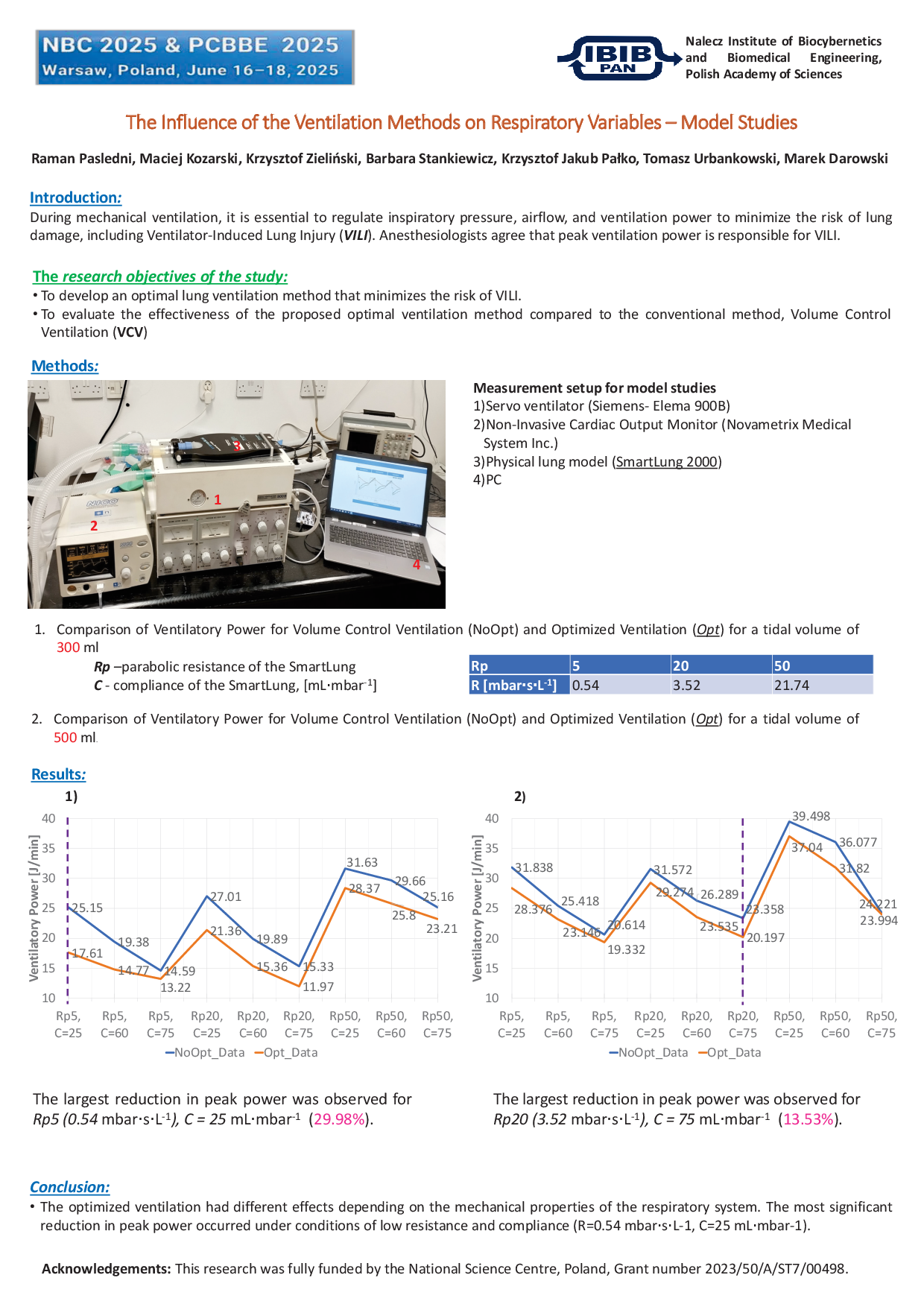
So, it was assumed in the project that the optimal ventilation method is the method to deliver a requested tidal volume to the lungs with a minimum inspiratory power. Thus, the research objectives in the project are the development of the optimal lung ventilation method, minimizing the risk of VILI and the assessment of the efficacy of optimal lung ventilation on a model of pathologically changed lungs. Clinical investigations are expensive, time-consuming and many patients are needed for investigations to obtain statistically proven results of studies. Besides, such institutional authorities like European Commission or the US Food and Drug Administration encourage researchers to diminish the number of animal experiments and replace them with in silico studies, especially in a preclinical phase. Contrary to clinical investigations, modelling of a ventilator-lungs system and usage of simulation to study their interaction is cheap, saves time and generally is easy to perform for experienced investigators equipped with proper experimental tools. It is also very important that studies on virtual patients, like lung models are devoid of ethical issues. To achieve the project objectives, the simulation investigation will be performed on the hybrid (pneumatic–computer) simulator of the hybrid respiratory system (HRS) developed in the IBBE PAS that enables the connection of a mechanical ventilator pump with a computer model of lungs inserted in the simulator, using impedance transformers (Fig. 1).
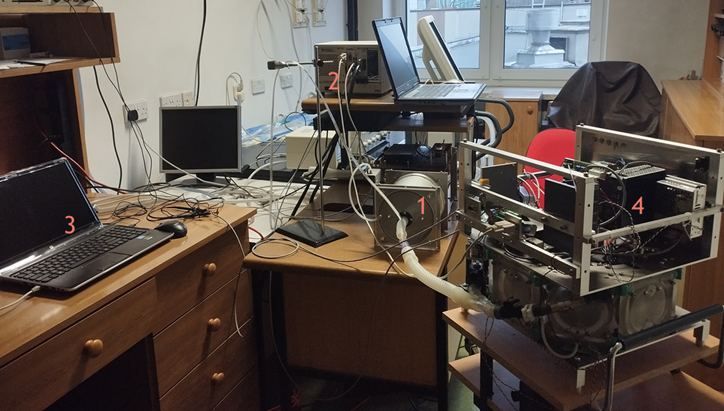
Fig. 1. The measuring set-up: the hybrid respiratory simulator (physical part) (1), PXI computer
(National Instruments) resolving in real-time equations of the numerical model of the respiratory system (2), a computer used to control the simulator (3) and the ventilation pump (4 ) (IBBE PAS).
Poster presentation - NBC 2025 & PCBBE 2025
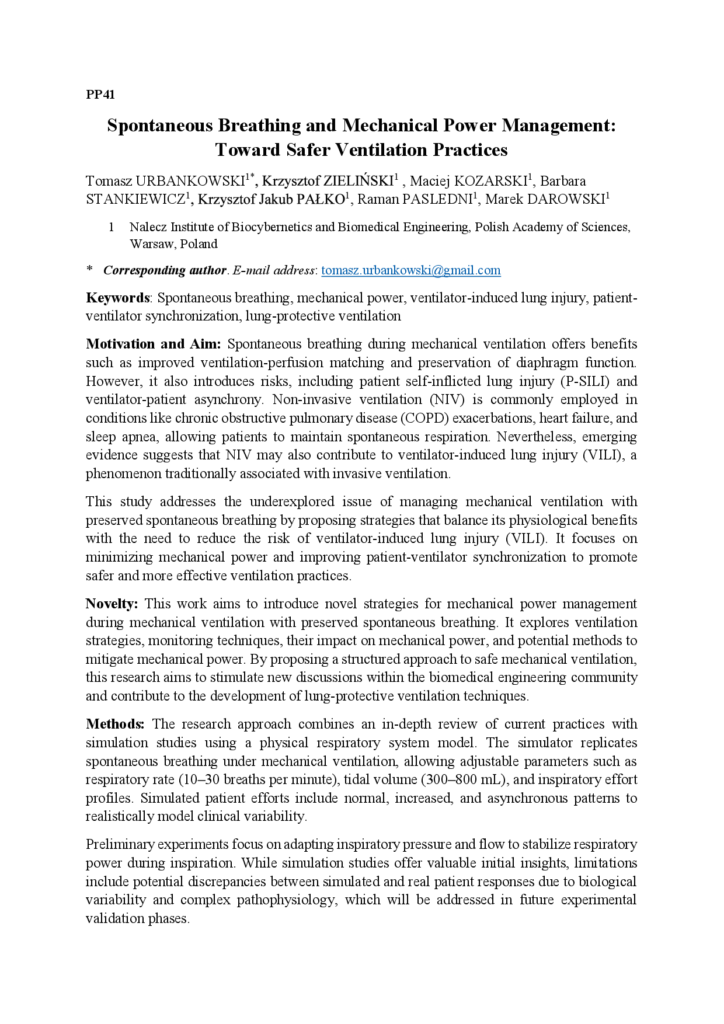
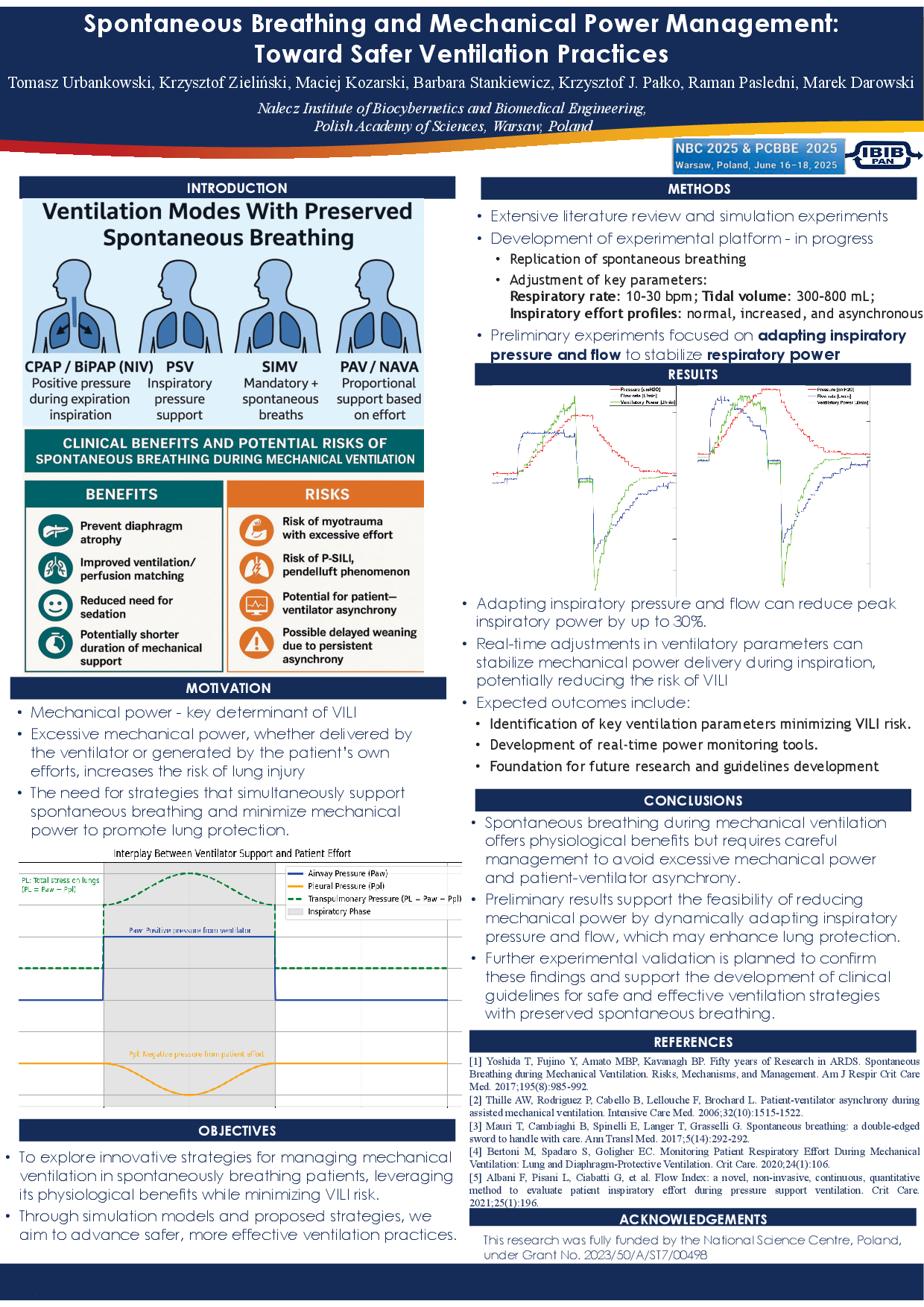
1 Urbankowski Tomasz, Kozarski Maciej, Stankiewicz Barbara, Pasledni Raman, Darowski Marek. Spontaneous Breathing and Mechanical Power Management: Toward Safer Ventilation Practices. Book of Abstracts (P41) of NBC 2025 & PCBBE 2025, June 16-18, 2025, Warsaw, Poland.
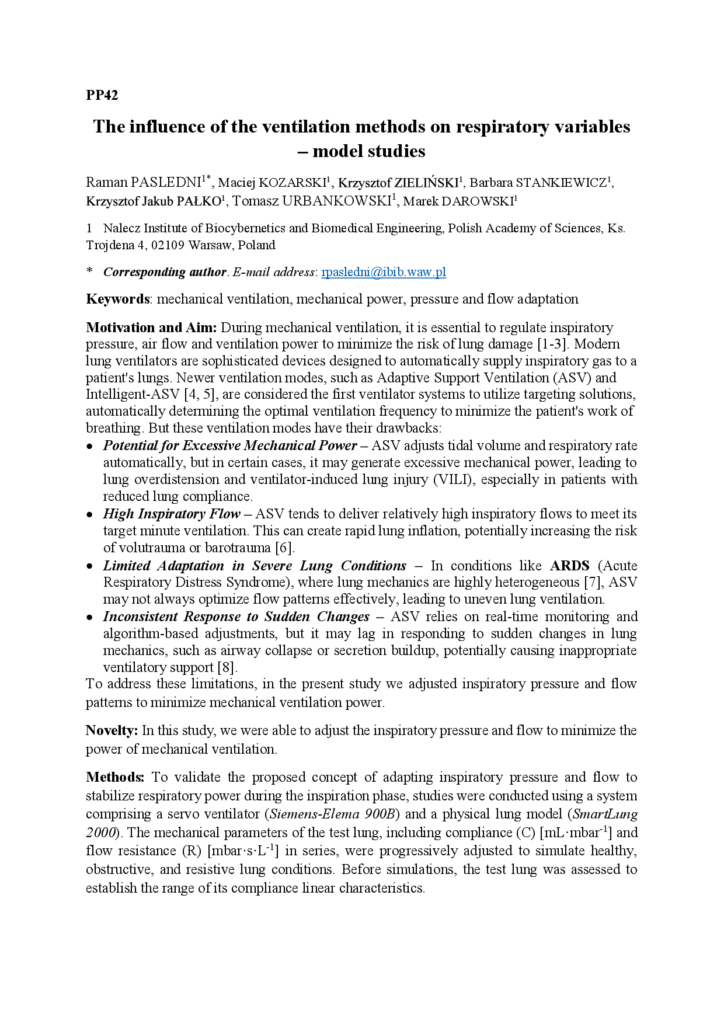
2. Pasledni Raman, Kozarski Maciej, Stankiewicz Barbara, Urbankowski Tomasz, Darowski Marek. The influence of the ventilation methods on respiratory variables. Book of Abstracts (P42) of NBC 2025 & PCBBE 2025, June 16-18, 2025, Warsaw, Poland.
Publications
- Marek Darowski, Raman Pasledni, Tomasz Urbankowski, Barbara Stankiewicz, Krzysztof Jakub Pałko, Maciej Kozarski, Krzysztof Zieliński. Reducing the risk of ventilator-induced lung injury through inspiratory pressure and flow adaptation: A proof-of-concept study. Biomedical Signal Processing and Control 115, 2026; 109405, https://doi.org/10.1016/j.bspc.2025.109405 (IF=4.9 (2024); 140 p. MNiW)
- Urbankowski T., Pasledni R., Darowski M. Mechanical power in mechanical ventilation and its association with ventilator-induced lung injury: A systematic review. Respir Med. 2025 Dec;250:108525. https://doi.org/10.1016/j.rmed.2025.108525. (IF=3.1 (2024); 100 p. MNiW)
