Continuous Monitoring System for Drainage Fluids for the Assessment of Treatment Progress in Patients with Secondary Bacterial Peritonitis
Project Overview
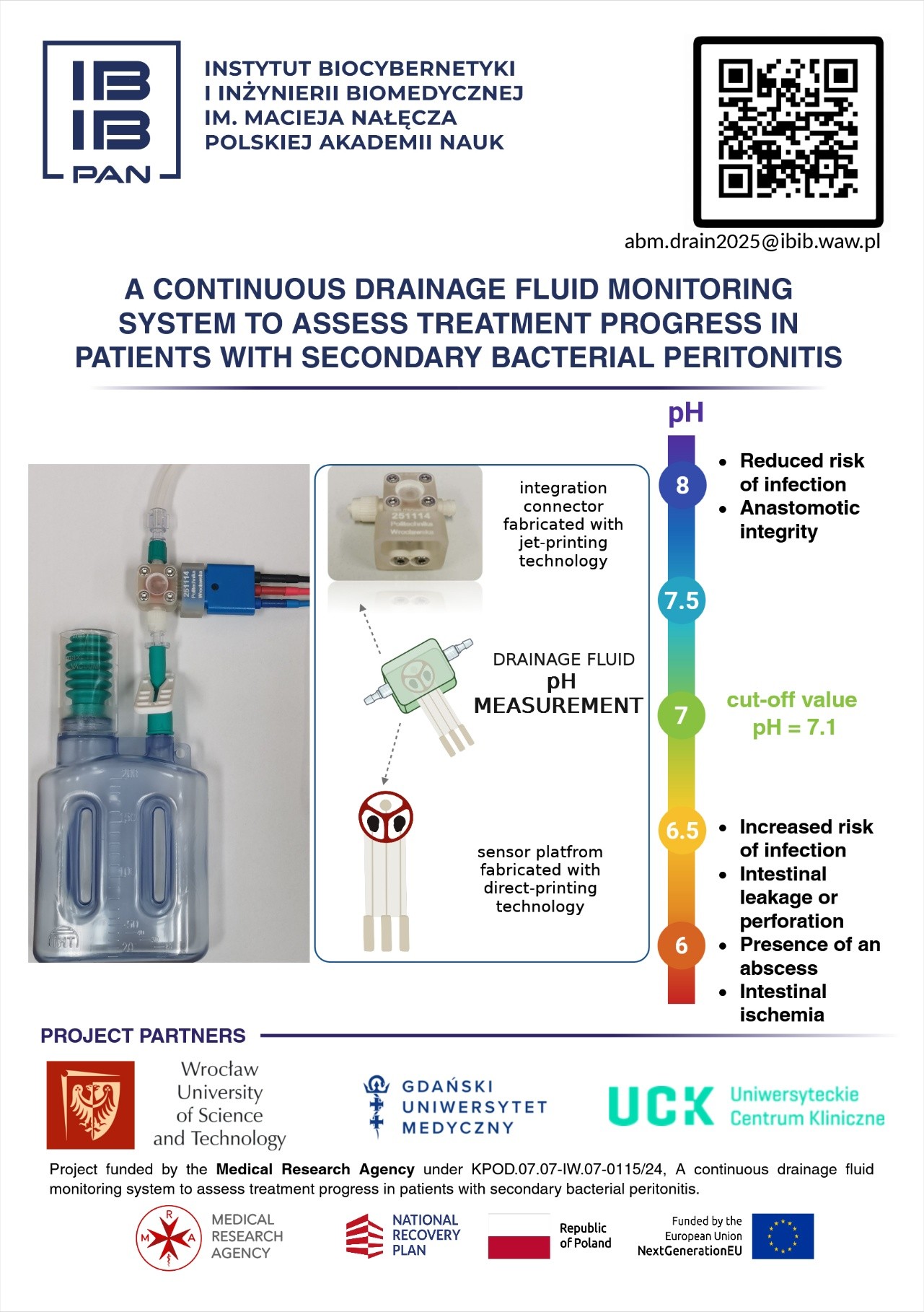
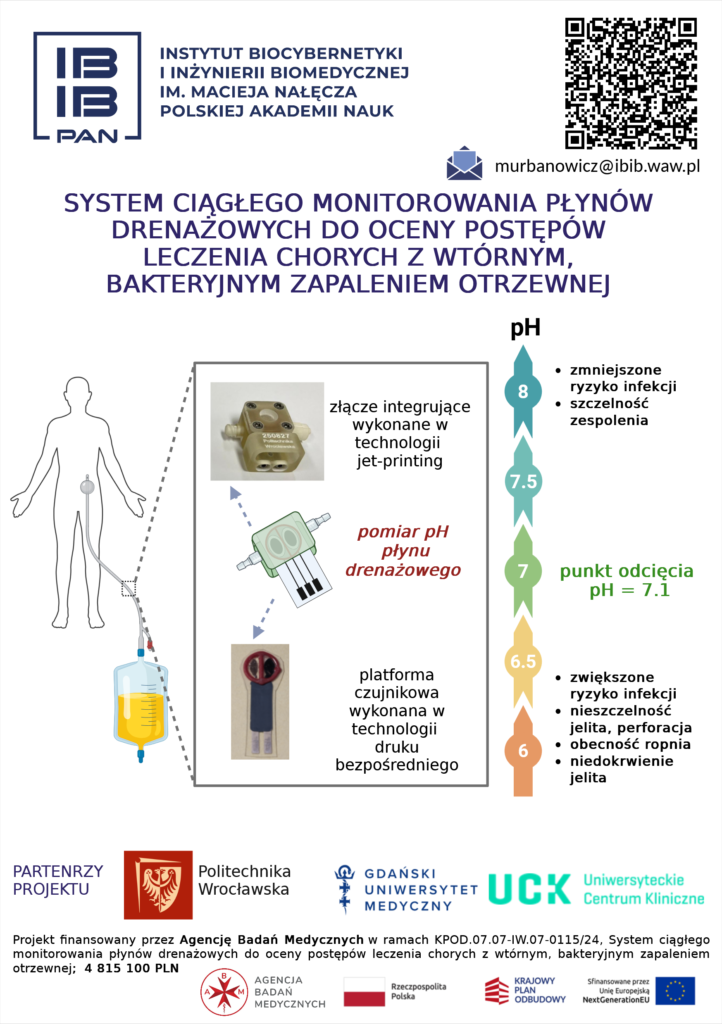
This project focuses on the development of an innovative analytical tool for continuous pH monitoring of drainage fluids collected from patients undergoing surgical treatment for secondary bacterial peritonitis. The proposed solution is based on a miniaturized pH sensor integrated with a surgical drainage system and developed at the Nalecz Institute of Biocybernetics and Biomedical Engineering, Polish Academy of Sciences. Secondary bacterial peritonitis is a severe and potentially life-threatening condition, most commonly caused by gastrointestinal perforation and subsequent contamination of the peritoneal cavity. Despite advances in surgical techniques and pharmacological treatment, it remains associated with high perioperative mortality. Effective postoperative monitoring is therefore essential for assessing treatment response and identifying complications at an early stage. The project addresses this clinical need through the development of a dedicated sensing platform for real-time pH monitoring of postoperative drainage fluids. Continuous measurement of this parameter may provide clinically relevant information on patient status, support timely therapeutic decision-making, and offer surgeons an additional source of information, including on potential gastrointestinal anastomotic leakage.
Scientific and Technological Concept
The project is based on the use of advanced direct-printing technology for the fabrication of a miniaturized electrode system to obtain highly stable and sensitive pH sensors. The developed devices are designed as planar, solid-state sensors without an internal liquid electrolyte, which facilitates their integration with drainage systems and supports their practical implementation in biomedical settings.
The scope of the project includes:
- fabrication of miniaturized planar pH sensor systems,
- development of pH measurement procedures that account for biofouling,
- development of a dedicated flow cell enabling integration of the sensor system with a drainage line,
- development of a protocol for the analysis of clinical samples collected from patients undergoing surgical treatment for secondary bacterial peritonitis.
Expected Impact
- The expected outcome of the project is a novel tool for postoperative monitoring of patients with secondary bacterial peritonitis.
- The proposed system is intended to improve treatment assessment by enabling continuous, near real-time monitoring of drainage fluid pH.
- In the long term, the project may contribute to the development of practical sensing solutions for modern surgical and oncological care.
Project Team
Project Leader: Marcin Urbanowicz, PhD, Eng. (IBBE PAS)
Chemical Technologist: Agnieszka Paziewska-Nowak, PhD, Eng. (IBBE PAS)
Direct-Printing Technologist: Marek Dawgul, PhD, Eng. (IBBE PAS)
Electrochemist: Kornelia Bobrowska, MSc (IBBE PAS)
Analytical Chemist: Anna Sołdatowska, MSc, Eng. (IBBE PAS)
Medical Consultant: Marcin Ekman, MD (University Clinical Centre in Gdańsk)LINK do BIO]
Supporting Staff
Biologist: Krzysztof Pluta, PhD (IBBE PAS)
Biotechnologist: Monika Wiśniewska, MSc (IBBE PAS)
SPR Research Support: Maria Baczyńska, Eng. (Warsaw University of Technology/IBBE PAS)
Technical Support: Gabriela Krasiejko, Eng. (Warsaw University of Technology/IBBE PAS)
Medical Support: Katarzyna Połomska (Medical University of Gdańsk/IBBE PAS)
Scientific Advisory Board
Dorota G. Pijanowska, Prof., PhD, DSc, Eng. (IBIB PAN)
Jarosław Kobiela, Prof., MD, PhD, DSc (University Clinical Centre in Gdańsk) [https://ppm.gumed.edu.pl/info/author/GUM879397daddeb4ed1af19eecfbc490e9b/]
Funding
The project is funded by the Medical Research Agency under the Governmental Plan for the Development of the Biomedical Sector for 2022–2031, with total funding of PLN 4 815 100.
Grant agreement no.: KPOD.07.07-IW.07-0115/24

Collaborations
- Department and Clinic of Oncological, Transplant and General Surgery, University Clinical Centre in Gdańsk,
- Faculty of Electronics, Photonics and Microsystems, Wrocław University of Science and Technology.
Intellectual Property
- Patent application: M. Urbanowicz, M. Dawgul, D. G. Pijanowska, Planar ion-selective microelectrode and method for its fabrication. P.448894 [WIPO ST 10/C PL448894] (2024).
Scientific article:
A. Paziewska-Nowak, M. Urbanowicz, M. Dawgul, K. Bobrowska, A. Sołdatowska, M. Ekman, D. G. Pijanowska, Highly stable direct-printed polyazulene-based miniaturized electrode for pH analysis in human body fluid, Biocybernetics and Biomedical Engineering, 46, 2026, 40-49 https://doi.org/10.1016/j.bbe.2025.11.008 IF: 6.6
Conference presentations:
- M. Urbanowicz, A. Paziewska-Nowak, K. Bobrowska, A. Sołdatowska, M. Dawgul, M. Ekman, D.G. Pijanowska, Direct-printed, solid-contact pH sensor for clinical applications: Challenges of non-specific adsorption, EUROSENSORS XXXVII, September 07-10 2025, Wrocław, https://www.ama-science.org/proceedings/getFile/AwZ3AN
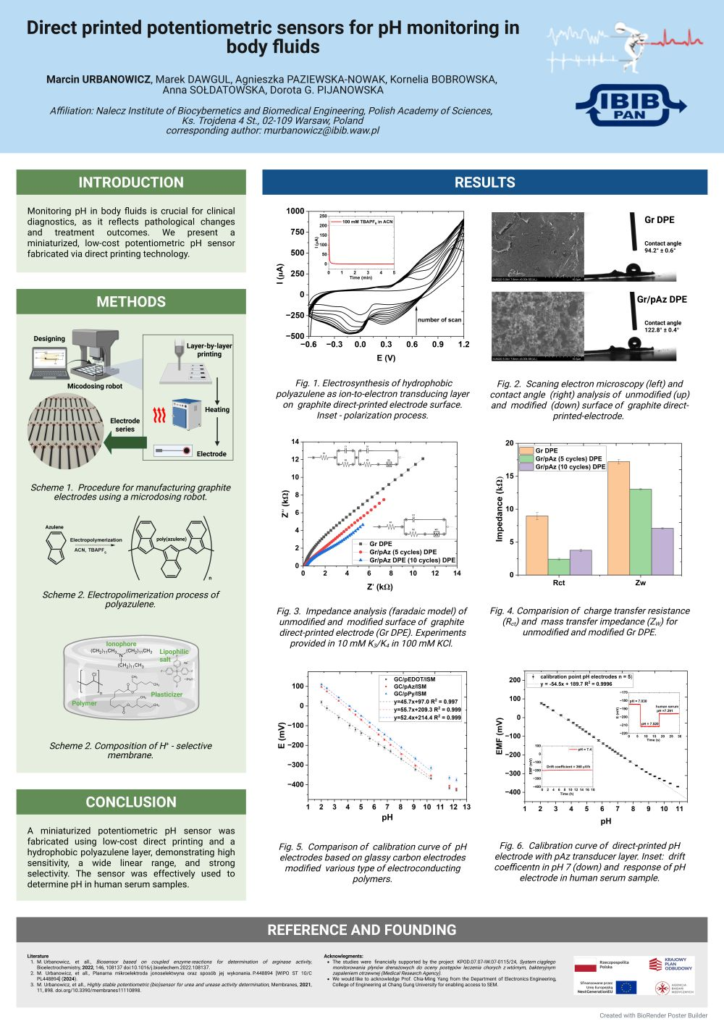
- M. Urbanowicz, M. Dawgul, A. Paziewska-Nowak, K. Bobrowska, A. Sołdatowska, D.G. Pijanowska, Direct printed potentiometric sensors for pH monitoring in body fluids, NBC 2025 & PCBBE 2025 – Joint 20th Nordic-Baltic Conference on Biomedical Engineering & 24th Polish Conference on Biocybernetics and Biomedical Engineering, June 16-18 2025, Warszawa
Training of Early-Career Researchers
Master’s theses:
- Investigation of functionalized electrodes fabricated using direct-printing technology for the construction of a potentiometric urea biosensor, by Maria Baczyńska, Eng.; Supervisor: Łukasz Górski, PhD, DSc, Eng.; Scientific advisor: Marcin Urbanowicz, PhD, Eng.
- Electrochemical characterization of electrode systems fabricated using direct-printing technology as substrates for potassium ion-selective sensors, by Gabriela Krasiejko, Eng.; Supervisor: Zuzanna Bojarska, PhD, Eng.; Scientific advisor: Marek Dawgul, PhD, Eng.
Updates
Kwiecień 2026
Finalny etap projektu: badania próbek płynów drenażowych pacjentów z wtórnym zapaleniem otrzewnej z wykorzystaniem opracowanego systemu czujników pH
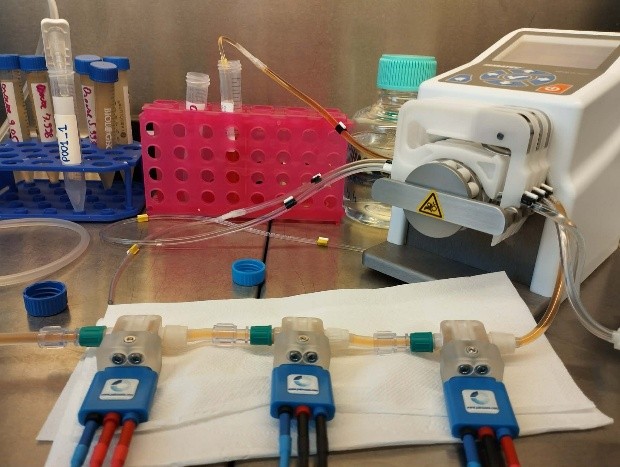
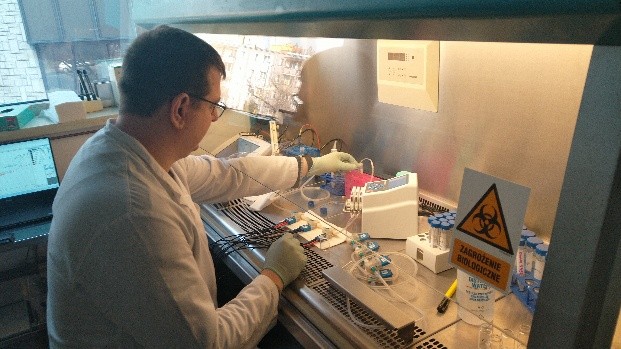
W ostatnim etapie projektu przeprowadzono badania z wykorzystaniem miniaturowego systemu czujników pH w warunkach przepływowych. Prace te stanowiły element weryfikacji funkcjonalności rozwiązania opracowanego w IBIB PAN do analizy pH próbek płynów drenażowych. Uzyskane wyniki potwierdziły możliwość zastosowania opracowanego systemu czujnikowego do oznaczania pH w płynach drenażowych w warunkach zbliżonych do planowanej aplikacji. Przeprowadzone badania zakończyły ostatni etap prac badawczo-rozwojowych projektu. Potwierdzając wysoki potencjał opracowanej technologii do dalszego rozwoju oraz przyszłych zastosowań wspomagania diagnostyki medycznej.
March 2026
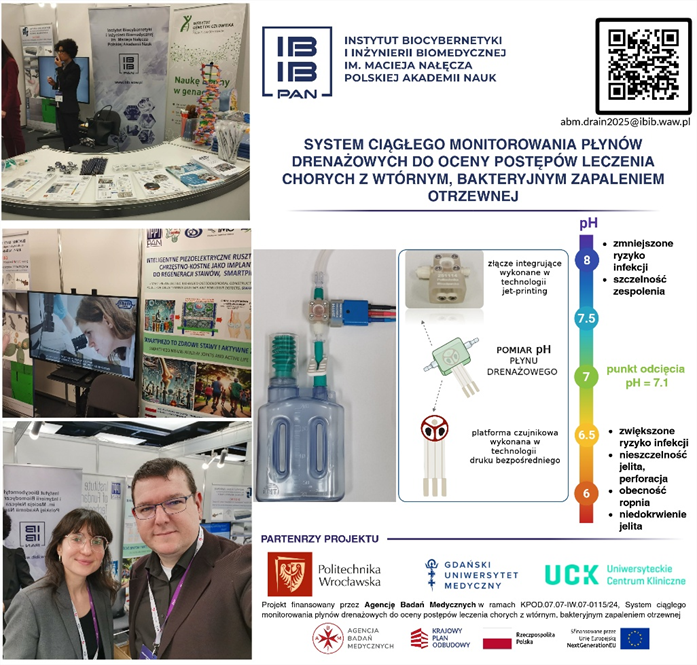
Targi LABS EXPO 2026
The project's results were presented at LABS EXPO 2026, held on 18–19 March 2026 in PoznańThe event provided an opportunity to present the project objectives and the translational potential of the developed solution for clinical pH monitoring in drainage fluids, as well as to exchange experience with representatives of the scientific and industrial communities.
February 2026
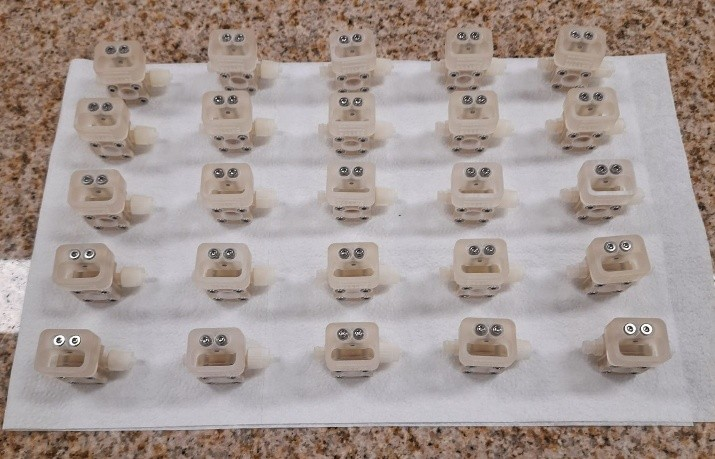
A new flow cell for the miniaturized pH sensors developed at IBBE PAS
As part of the project, a series of flow cells was produced using 3D-printing technology (Material Jetting). These flow cells enable integration of the miniaturized pH sensors developed at IBIB PAN with drainage systems and allow studies to be carried out under flow conditions. The flow cell was developed in collaboration with Wojciech Kubicki, PhD, Eng., from Wrocław University of Science and Technology, who also delivered a seminar at IBIB PAN on structural solutions in microfluidic systems and 3D printing, and their research applications.
January 2026
Expansion of IBIB PAN research infrastructure through MRA funding
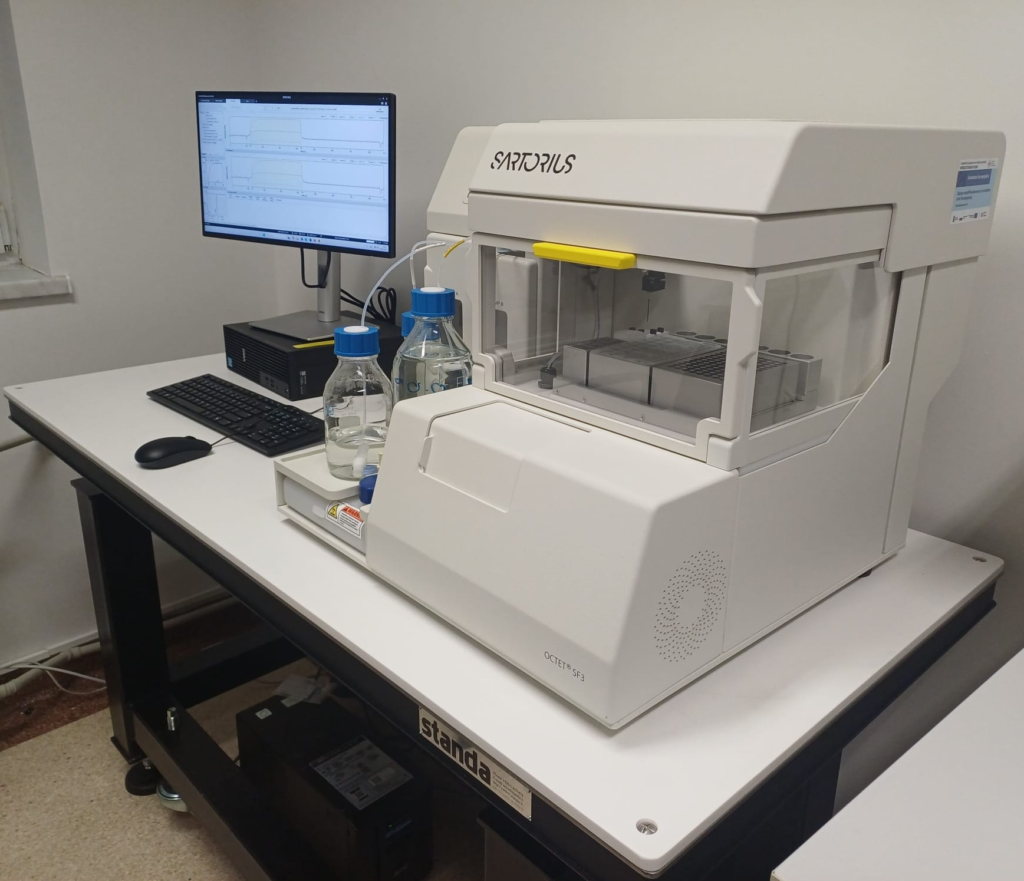
As part of the project, the research infrastructure of IBIB PAN was expanded with a modern surface plasmon resonance (SPR) instrument. This is the first Octet® SF3 system in Poland and among just seven available in Europe. The implementation of this instrument represents an important step in ongoing research, enabling label-free, real-time analysis of molecular interactions, including the assessment of non-specific interactions between drainage fluid components and sensor surfaces. Its advanced capabilities include concentration-gradient measurements, allowing kinetic and affinity parameters to be determined during a single sample injection.
This substantially shortens experimental time, reduces sample consumption, and minimizes the risk of sample-preparation errors. In addition, the system enables fully automated measurements while maintaining high signal stability, which is particularly important in studies involving biological samples with complex matrices. The platform will also support future research on the development of new biosensors for clinical applications.
December 2025
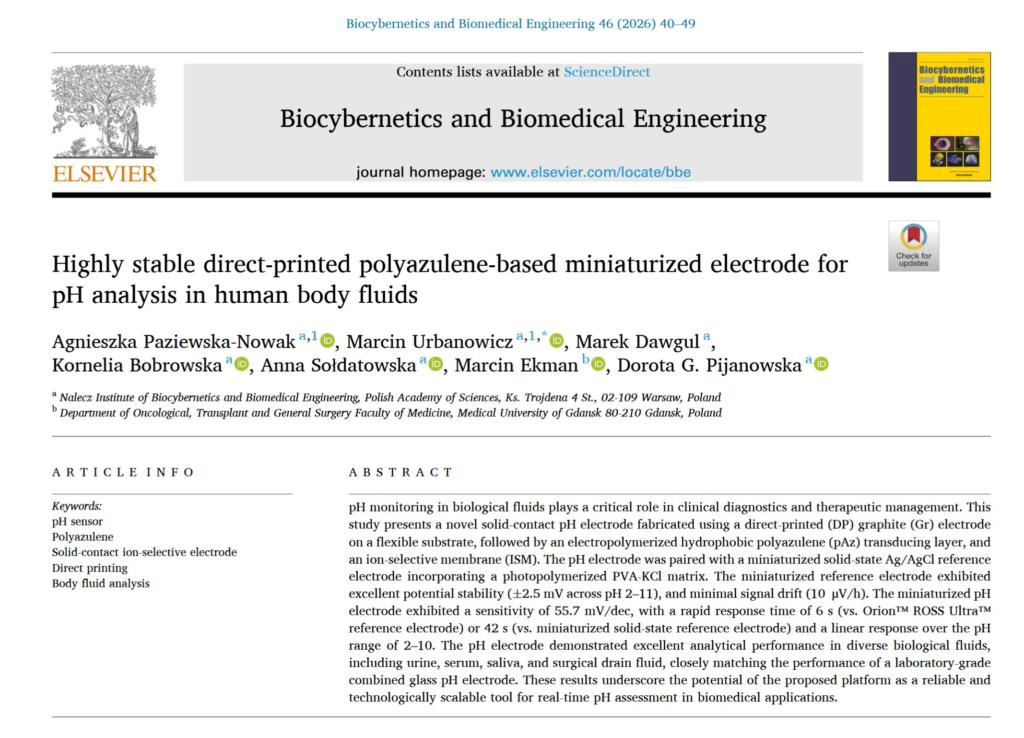
Next step towards clinical application: testing with patients’ drainage fluids and publication in the Biocybernetics and Biomedical Engineering journal
Research results obtained within the project were published in a leading scientific journal indexed in JCR in the Biomedical Engineering category: A. Paziewska-Nowak, M. Urbanowicz, M. Dawgul, K. Bobrowska, A. Sołdatowska, M. Ekman, D. G. Pijanowska, Highly stable direct-printed polyazulene-based miniaturized electrode for pH analysis in human body fluid, Biocybernetics and Biomedical Engineering, 46, 202640–49, IF: 6.6, ministerial score: 140. https://doi.org/10.1016/j.bbe.2025.11.008
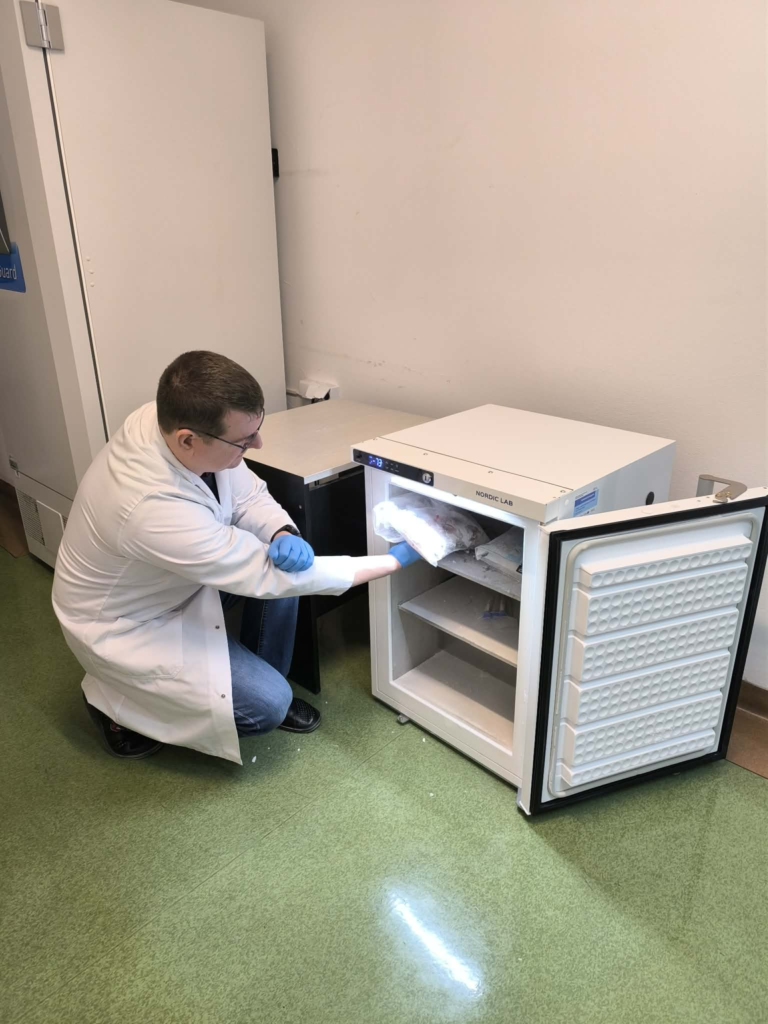
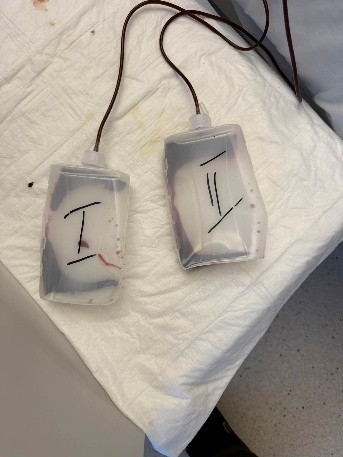
As part of the collaboration with the Medical University of Gdańsk, drainage fluid samples from patients treated for secondary peritonitis were delivered to IBIB PAN. This enabled the first tests of the developed pH sensors using biological material collected from patients.
November 2025
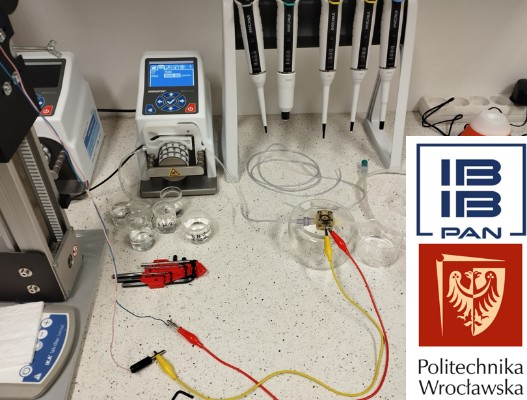
Testing of pH sensors under flow conditions
The developed pH sensor was tested under flow conditions using a dedicated flow cell developed in collaboration with Wrocław University of Science and Technology. These studies confirmed the correct operation of the miniaturized pH sensors under dynamic conditions and represented another step towards the clinical translation of the developed solution.
October 2025
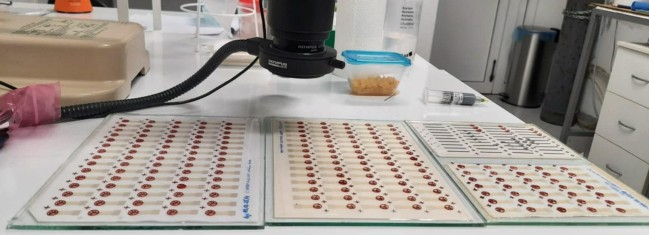
From components to integration: the pH sensor ready for further testing
The integration of the miniaturized pH electrode with the miniaturized reference electrode into a single measuring system marked another important milestone in the project. A compact and functional pH sensor was designed and fabricated to support the diagnosis and monitoring of patients with secondary peritonitis.
The project was also presented at the 15th Mazovia Development Forum, where the team had an opportunity to showcase the results obtained to date. https://www.ibib.waw.pl/pl/1394-15forum-mazowsza
September 2025
From laboratory research to real clinical needs
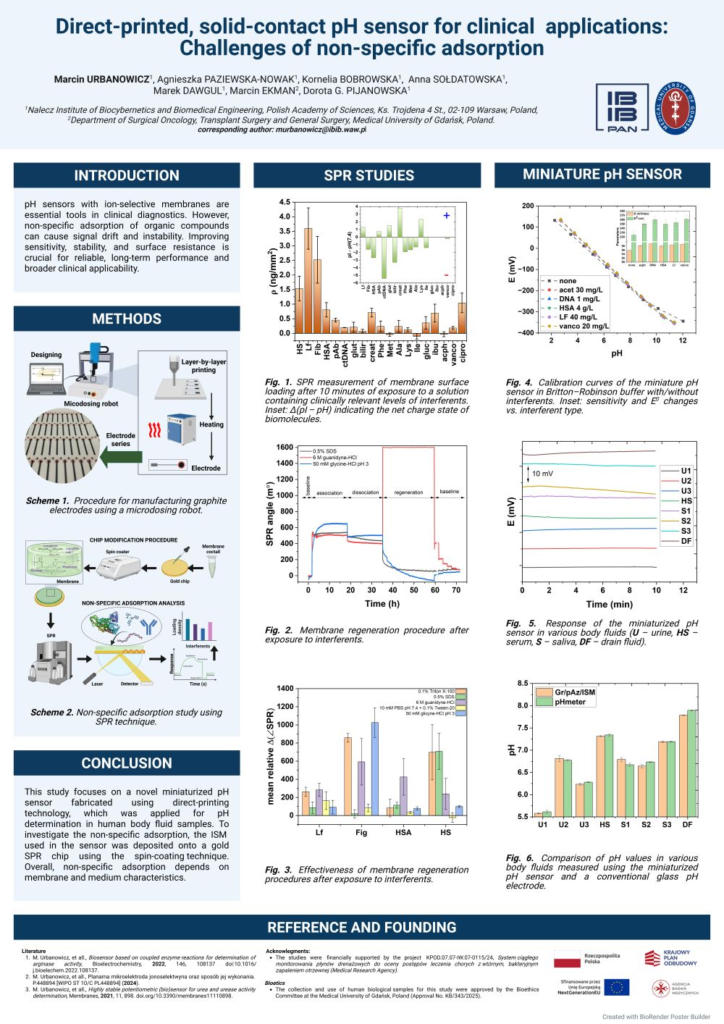
Research findings on the influence of non-specific adsorption of drainage fluid components were presented at the EUROSENSORS XXXVII conference, held on 7–10 September 2025. The poster entitled „Direct-printed, solid-contact pH sensor for clinical applications: Challenges of non-specific adsorption” highlighted both the technological progress achieved and the clinical relevance of the identified challenges.
The IBIB PAN project team also participated in a networking meeting with clinicians organized by Professor Jarosław Kobiela, Head of the Department of Oncological, Transplant and General Surgery at the University Clinical Centre in Gdańsk. The meeting, held on 24-26 September 2025, strengthened the dialogue between engineers and physicians and supported the identification of future clinical applications of the technologies being developed within the project. More info on website:
• https://www.ibib.waw.pl/pl/1392-ibib-pan-rozwija-innowacje-dla-chirurgii
• https://kkcotio.gumed.edu.pl/86507.html
July 2025
A new miniaturized reference electrode and approval for studies involving drainage fluids from patients with secondary bacterial peritonitis
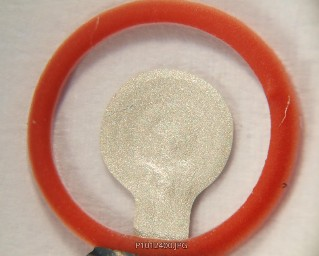
A new miniaturized reference electrode, fabricated using direct-printing technology and free of internal electrolyte, was developed within the project. This represented another important step in improving the miniaturized pH sensing platform.
The project also received a positive opinion from the Bioethics Committee of the Medical University of Gdańsk (no. KB/343/2025), enabling studies on drainage fluid samples collected from patients with secondary bacterial peritonitis. This was a key step towards clinical validation of the developed solution.

June 2025
Results of the MRA-Funded project presented at an international conference
The first research results were presented at the international conference NBC 2025 & PCBBE 2025, held on 16–18 June 2025, in the presentation entitled "Direct printed potentiometric sensors for pH monitoring in body fluids”.
May 2025
Miniaturized pH-sensitive electrodes fabricated using direct-printing technology
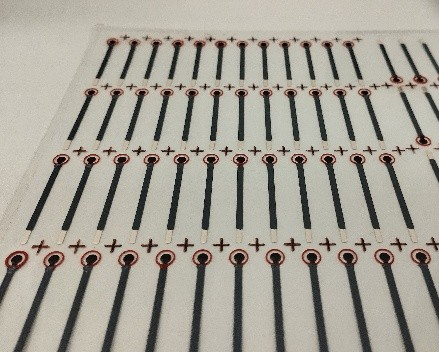
The project team developed an innovative miniaturized pH electrode fabricated using direct-printing technology. This solution opens the way to compact, flexible, and easily integrated ion-selective sensors for modern biomedical and clinical applications.
March 2025
Project agreement signed
In March 2025, the agreement for implementation of the project was signed. The project is funded by the Medical Research Agency under the Governmental Plan for the Development of the Biomedical Sector for 2022–2031. The total funding amount is PLN 4 815 100. Grant agreement no.: KPOD.07.07-IW.07-0115/24.

February 2025
MRA funding awarded to the project
The project received funding from the Medical Research Agency under the call for application-oriented research projects and was included on the ranking list of the MRA 2024 call. The awarded funding amounted to PLN 4 815 100.
Kwota uzyskana na ten cel to 4 815 100 PLN.

Lista rankingowa: https://abm.gov.pl/pl/konkursy/archiwalne-nabory-1/2024/2634,Konkurs-dla-jednostek-naukowych-na-realizacje-badan-o-charakterze-aplikacyjnym-w.html
Contact:
abm.drain2025(at)ibib.waw.pl
murbanowicz(at)ibib.waw.pl
