News

NANOSMAT 2026

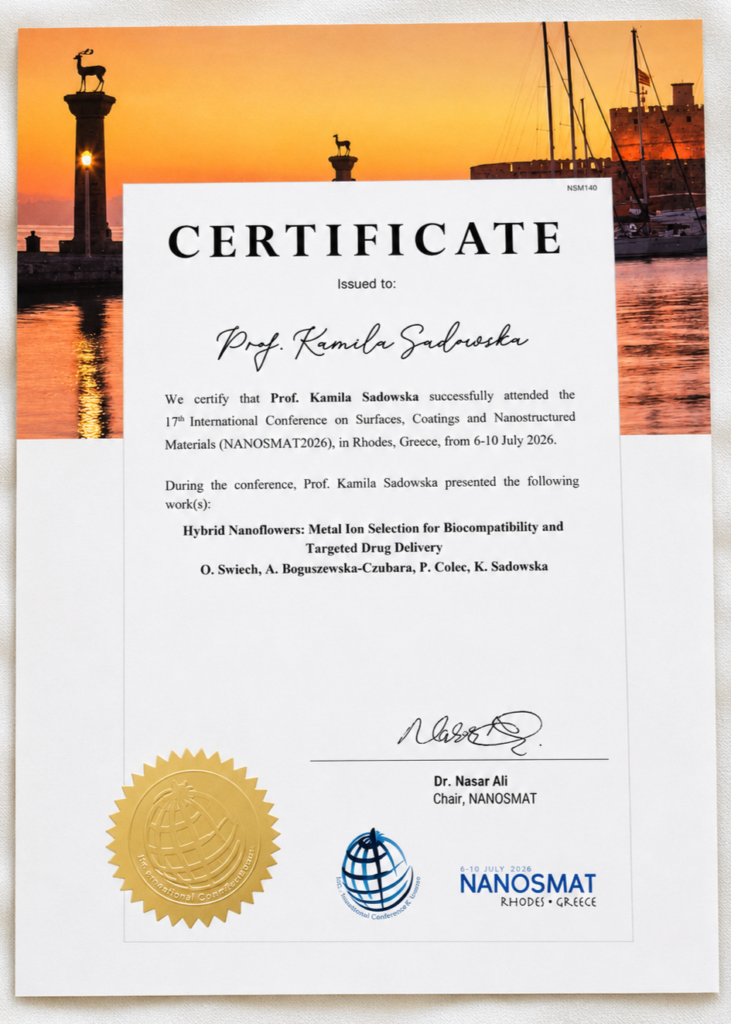
From 6–10 July 2026, I participated in the 17th International Conference on Surfaces, Coatings and Nanostructured Materials (NANOSMAT 2026), which was held on the island of Rhodes, Greece. During the conference, I presented the results of our research in a talk entitled “Hybrid Nanoflowers: Metal Ion Selection for Biocompatibility and Targeted Drug Delivery”, focusing on the influence of metal ion selection on the properties of hybrid nanoflowers in the context of biocompatibility and targeted drug delivery. I would like to sincerely thank the co-authors of the work – Olga Święch, Anna Boguszewska-Czubara, and Piotr Golec – for their fruitful collaboration. I also thank the conference participants for the engaging discussion and valuable questions following the presentation.

Nanoflowers on the air

📻Spring is here, and nanoflowers are blooming… on the air! 🌸 I joined Cezary Łasiczka on TOK FM's "OFF Czarek" to discuss the incredible potential of nanoflowers. We covered everything from their structure to their role in targeted drug delivery and the future of medicine. Check out the full interview to learn more!https://audycje.tokfm.pl/podcast/190871,Czym-sa-nanokwiaty

They are writing about us!

Information about our project, "Local antibiotic delivery systems for the treatment of bone and bone marrow infections," was published today on the University of Warsaw’s Faculty of Chemistry website. The project is funded by the MNiSW "Science for Society II" program (no. NdS-II/SP/0335/2023/01). Special thanks to Olga Święch for her contribution to the research on organic-inorganic nanoflower-structured drug carriers.

Link to the article: https://www.chem.uw.edu.pl/2026/03/04/hybrydowe-nanostruktury-znbsa-do-kontrolowanego-uwalniania-ciprofloksacyny-w-terapii-zakazen-kosci/

Polish-developed "nanoflowers" to support treatment of serious bone infections

"Polish scientists have developed microscopic 'nanoflowers' that allow antibiotics to be delivered directly to the infected bone. This makes the drug faster, more effective, and less toxic. It could be a breakthrough in treating osteomyelitis – a dangerous bone and bone marrow disease that can lead to bone necrosis and growth disorders in children". This is how the Polish Press Agency (PAP) described our work on the "Science in Poland" portal. Read the full article here:

https://naukawpolsce.pl/aktualnosci/news%2C112153%2Cpolskie-nanokwiaty-pomoga-w-leczeniu-groznej-choroby-kosci.html

Publication on Zn-BSA nanoflowers

In our paper “Development of Biocompatible Ciprofloxacin-Loaded Zinc–Bovine Serum Albumin Nanoflowers as Nontoxic Platform for Local Drug Delivery,” recently published in Nanotechnology, Science and Applications, Taylor & Francis Group we present biocompatible nanoflowers designed for localized antibiotic delivery. In vitro and in vivo studies confirmed the platform's safety and effectiveness in reducing the toxicity of ciprofloxacin, demonstrating its potential for therapeutic applications. Full article here: https://doi.org/10.2147/NSA.S574498

Blooming nanoflowers

Beyond the fading autumn light, a hidden garden of scientific wonder blossoms at the nanoscale. Nanoflowers are not only visually pleasing, but thanks to their large surface area and unique physicochemical properties, they are used in catalysis, sensors, medicine, energy, and environmental cleanup.
Below are SEM images of nanoflowers composed of copper phosphate and laccase; manganese phosphate and laccase; zinc phosphate and glucose oxidase, and copper phosphate and urease.